Showing posts with label Independents. Show all posts

Sunday, August 8, 2010

Penn State-Nebraska: A rivalry revived?

Under the flood lights on a crisp late-September Pennsylvania Saturday night in 1982, Penn State quarterback Todd Blackledge threw a first down pass to tight end Kirk "stone hands" Bowman in the back of the endzone with just four seconds remaining on the game clock. The last-gasp effort barely found its target. Bowman needed to scoop the ball off his laces with his body moving backwards to make the grab. Somehow he reeled the ball in and his third score of the day overturned a 24-21 deceit to Nebraska, giving the Nittany Lions a precious victory that propelled them toward an eventual first AP title in school history.

One minute and eighteen seconds of clock-time previously, Penn State had begun its final offensive possession of the game sixty-five yards from goal needing a touchdown to win. A personal foul penalty against Nebraska on the preceding kick-off helped matters, but with momentum apparently shifting and the famous 'Husker Blackshirt D on the other side of the line of scrimmage a score seemed unlikely. Nebraska's junior quarterback Turner Gill had capped a scoring drive that ate precious clock in the fourth quarter's waning minutes with a one-yard TD plunge.

That score gave Big Red its first lead of a game Penn State had controlled since a fourteen-yard Blackledge pass to Bowman completed an 84-yard scoring drive after only four minutes. 1982 was the first year of his tenure that Joe Paterno truly emphasized the passing attack. Blackledge was simply too good to under-utilize. He had thrown for four touchdowns in each of Penn State's first three games and threw for three more and 295 yards on 23-of-39 attempts vs. Nebraska. His 2,218 yards with 22 touchdowns as a senior lifted him to second in school career passing totals. Such productivity made for an impossing backfield. Alongside Blackledge running back Curt Warner [who had gashed Nebraska for an incredible 238 yards the previous year] racked up a thousand-yard season en route to graduating with a career total of 3,398, which remains the school record. When Warner broke loose for a 31-yard dash to the 'Husker four-yard line in the second quarter before finishing the drive with a two-yard TD run moments later, Gill and Co. faced a major uphill battle.

The situation was far from ideal for Tom Osborne's second-ranked Cornhuskers. With a loaded backfield featuring future Heisman Trophy winner Mike Rozier and a returning thousand-yard rusher in Roger Craig, Gill preferred to run the option rather than pass down field. When necessary Gill certainly could pass effectively. He graduated a year later standing second on Nebraska's all-time passing list. But with a rushing attack that had accounted for 677 of Big Red's NCAA-record 883 yards total offense during a 68-0 drubbing of New Mexico State the previous week, why pass? On the year Nebraska's three leading rushers alone would combine for 2,844 yards. The following season the 1983 Cornhusker backfield set what is still the school's single-season rushing record with a combined 4,820 yards. Even when compared to the unstoppable ground attacks of the early-1970s and late-1990s, the Nebraska running game of the mid-1980s constitutes a definite high watermark.


Despite their unquestionable pedigree, the Big Red backfield learned on September 25th 1982 that running roughshod over New Mexico State and lining up opposite "Linebacker U" were different matters. Joe Patterno's defense limited Nebraska to a relatively innocuous 233 team rushing yards, and actually caused Craig to leave the game at half time with a strained thigh. Never-the-less, Gill performed as required and dragged his team back into contention with the balanced approach required. The 'Husker signal-caller went 16-for-34 through the air for 239 yards, earning him media plaudits as Big Eight player of the week. With only 38 ticks remaining before halftime Gill threw a 30-yard touchdown strike to I-back Irving Frazier. Then six minutes after Blackledge restored Penn State's 14-point cushion on a pass to flanker Kenny Jackson early in the third quarter, Gill struck again with a scoring strike to Rozier. Nebraska simply refused to go away and it was hardly a surprise when Osborne's team overcame the hostile road environment to seize its late lead inside the final two minutes.

Gill's touchdown dive set up a final, decisive Penn State possession that featured both drama and controversy. Blackledge marshaled his team with apparent ease to the Nebraska thirty-four before the Blackshirts recovered to collapse three consecutive plays at or behind the line of scrimmage. With only 17 seconds remaining, facing a fourth-and-eleven situation and trailing 21-24, Paterno considered for the first time in the game [as he later admitted] going for a tie. But with his place-kicker, Massimo Manca, having already missed three attempts on the day, the Penn State coach decided to try fortune's favor with an ounce of bravery instead. The gamble paid off when Blackledge shot an absolute bullet to Jackson just a step beyond the first-down marker at the NU twenty-three. Blackledge then scrambled for six more before Penn State gained nothing on second down.

It was at that moment that the game attained college football infamy. With all of the team's timeouts expended, Blackledge went deep along left sideline to his other tight end Mike McCloskey. The Nittany Lion receiver was heading out of bounds as the ball reached him and the play ended with him well into the Nebraska bench area. Osborne and Co. could not believe their eyes when the sideline umpire signalled a catch, giving Penn State a first-and-goal from the two with those four precious seconds remaining. Nebraska coaches and players were still crying bloody-murder when Bowman fell backwards out of the endzone clutching his third TD ball of the day, giving number eight Penn State a banner victory as the clock expired.


The call, which was unquestionably wrong, had far-reaching repercussions for both teams. After having gone undefeated in 1968, 1969, and 1973 without winning a national championship, Joe paterno finally gained the AP voters' respect in 1982 despite picking up a loss. The '82 Nittany Lions finished the season 11-1 with a 21-42 road loss to Paul Bryant's Crimson Tide. Despite that loss, several key wins earned the necessary grace for Penn State to be voted number one over 11-0-1 SMU following the bowls. Penn State's opponents combined for a national best record of .687. On New Year's Day, while Nebraska only managed a narrow 21-20 Orange Bowl win over 8-2-1 LSU and SMU failed to impress en route to a 7-3 victory over 9-2 Pitt in Dallas, the Nittany Lions knocked off Herschel Walker and the number one Georgia Bulldogs in New Orleans. Wins over Notre Dame and Nebraska combined with Penn State's impressive Sugar Bowl victory to crown a national championship resume. Without a blown call in the dying seconds on September 25th, the 1982 Nittany Lions would have been just another very good 10-2 Paterno team.

Conversly, that same call caused Tom Osborne to extend his wait for a national championship by another year. The drought eventually lasted to 1994. Big Red finished the 1982 season 11-1 and placed third in the final AP poll. As a senior the following year Turner Gill led his team to a perfect 11-0 regular season and a third consecutive Orange Bowl berth before an endzone pass from the two-yard line once again proved decisive. By the final minute of the game Nebraska had clawed back from 17-0 and 31-17 defecits to reach 31-24 with possession of the football inside the Miami Hurricane thirty. In an uncanny echo of Blackledge's final drive in State College fifteen months previously, three consecutive 'Husker plays garnered little success. Facing fourth-and-eight Osborne called an option play which Gill kept himself, bursting twenty-four yards for the endzone. Down 30-31 number one Nebraska would likely have been voted national champion with an extra point and the tie. But Big Red didn't play for ties. Letting the chips ride for it all, Gill rolled right on a two-point attempt and passed to an open receiver at the front of the endzone. For 'Huskers time slowed to a creep as they watched Miami safety Ken Calhoun close the gap, stretch his body, and put fingertip to ball for a championship-winning deflection. Somehow Nebraska's prolific offenses of the early 1980s never won a national title.

Penn State and Nebraska have played one another on thirteen occasions. Once back in 1920, five times between 1949 and 1958, for a two-game series in 2002 and 2003, and for five straight seasons from 1979 to 1983. The two schools have met six times in State College, six times in Lincoln, and once in the Kickoff Classic at Meadowlands Stadium -- a game in which the 1983 'Huskers meted out bloody vengeance on the graduation-ravaged Nittany Lions for the disappointment inflicted the preceding season. Of these thirteen meetings the five games played during the early-1980s naturally define the identity of the series. Two powerhouse programs known for their old school style and understated dignity clashed with full force at the height of their respective powers. Two massive fan bases in football-obsessed states watched with bated breath as their schools placed national championship aspirations on the line to test their mettle against the best. Nebraska won the first two bouts, 42-17 and 21-7, before Penn State answered in kind 30-24 in Lincoln and so famously in that 27-24 triumph at Beaver Stadium. Sadly, Nebraska's 44-6 romp the following year was the last word on the matter for two decades.

Nebraska finished the 1979 season ranked 9th in the AP poll, Penn State 20th. The following year they polled 7th and 8th respectively. Penn State finished the 1981 season 3rd with Nebraska polling 11th. A year later the Nittany Lions were crowned national champion with Nebraska on their heels in 3rd. In 1983 Big Red finished only behind Miami thanks to their failed two-point attempt, while Penn State followed their disastrous start in New Jersey with an 8-4-1 season to finish unranked for the first time since 1976. Penn State's narrow victory in 1982 helped earn Joe Paterno a national championship. Had the Nittany Lions lost, Nebraska would almost certainly have claimed that laurel. The next year Big Red all but did just that. Simply put, Penn State and Nebraska's games between 1979 and 1983 mattered. And they were nothing if not memorable. The two programs which are perhaps more than any others virtual mirror images of one another provided matchups that built expectations without failing to deliver. It is only a shame they did not continue to play after the '83 Huskers' lopsided coming-out party at the Meadowlands.

Presently Big Ten commissioner Jim Delany is considering his newly-expanded league's options for dividing its twelve members into two divisions for football. There are many issues to consider that needn't be rehearsed here. It only need be pointed out that Nebraska has lacked a true annual rivalry game against a conference foe of equal stature since the Texan invasion/hostile takeover of the old Big Eight in 1995. Penn State has perhaps never had a true annual rival. The Big Ten's grand plan to manufacture one via the uninspiring Land-grant Trophy series with Michigan State has been quite the flop. Geography is hardly good grounds for objection in a league with a footprint that now stretches from Philadelphia to a little more than one hundred miles from the Rockies. And more importantly, the Big Ten added Nebraska to increase the relevance and national exposure of its football teams.


Imagine this scenario for the last two weeks of conference play:

Michigan plays Ohio State for one division title. A few hours later Nebraska faces Penn State to decide the other. The following week the winners face off with national championship implications likely at stake.

What could possibly be more appealing and nationally relevant than that?


(Sources: Huskers.com; Michael Weinreib, Daily Collegian; Heisman.com; collegepollarchive.com; USA Today CFB encyclopedia; ESPN Big Ten Encyclopedia; cfbdatawarehouse.com)

Saturday, June 26, 2010

Forward to the Past: the SWC reborn?

A busy off-season of college football rumor-mongering and high-stakes brinkmanship appears to have ended a long way short of the "revolutionary" realignment that seemed all but a done deal until the 11th hour of the twelve-day Big XII missile crisis. A sport which often infuriates even its most loyal partisans by the almost imperceptible slowness with which it reforms itself off the field appeared to be on the very verge of a near instantaneous leap into the far reaches of an utterly unkown future. The men at the very center of the game made public comments based on the assumption that this shift would certainly take place. Bob Stoops referred to the proposed Pac-16 as "very exciting" and indulged in on-the-record comments about Oklahoma's prospective new conference rivalries. Deloss Dodd's, the ever-present University of Texas Athletics Director, gathered his school's coaches to inform them that the Big XII was dead and that the Longhorns would be heading west.

Then... nothing. Or almost nothing. The Mountain West switched Utah for Boise. The two most old-school conferences finally got a championship game by adding Nebraska to the Big Ten [12] and Colorado and Utah to the Pac. The Big XII [10] decided that championship games are for conferences that like making life harder for their champions and engaging in actual competition. Notre Dame breathed a sigh of relief. And that was all.

The question we are left with is whether the crazy off-season of 2010 ["expansion-palooza" as some are calling the affair] was a near total shakeup masterminded by a single outsider [former Tennis executive now Pac-12 commissioner Larry Scott] or the next incremental step in a gradual, inexorable evolution toward the long expected "age of the super-conference." Due to the lightening pace at which rumor became event and event became non-event there is, I think, a general tendency to view this entire affair as an aberration. Many commentators are giving Larry Scott massive credit for "shaking up" the stolid, crusty Pac-10 and coming nearer than any thought possible to advancing college football more than one step forward in a single move.

Viewed in light of the conversations that surrounded the last major wave of realignment, however, this summer's events seem less unprecedented and revolutionary. Back in 1988 then SEC commissioner Roy Kramer spotted a potentially lucrative loophole in an NCAA by-law that implicitly did not apply to football. The rule states that conferences made up of twelve or more members may decide regular-season champions through championship games. Kramer accurately predicted that a one game playoff for a two-division, twelve-member SEC could generate massive revenue as well as the national prestige with pollsters that the league had historically lacked. The search was on for the best fitting two schools to incorporate.

Meanwhile, the once-mighty Southwest Conference was undergoing an existential crisis. No SWC school could boast a national championship since the 1970 Longhorns. During the ensuing two decades every member institution barring Rice, Baylor, and Arkansas had met with major NCAA sanctions on account of cheating scandals. A negative cycle of pay-for-play slush fund arms races and rival schools turning one another in to the authorities culminated with SMU receiving a one-year total suspension of its football program after the 1986 season. There was some symmetrical justice in this move as it had been ultra-rich oilman and SMU booster William Clements who first set the league on its slippery slope to financial depravity. By 1986 Clements occupied the Texas governor's mansion. The unrepentant Mustang-backer sensationalized a state whose tolerance for football motivated madness is remarkably high by instructing SMU to continue its slush fund payments to players even after existence of the practice had come to public light.

Cash incentives for players and recruits had been an open secret in the SWC for years. Gary Shaw claimed in his sensational 1972 expose on the Darrell Royal regime, Meat On The Hoof, that on his recruiting visit to SMU coaches had unabashedly asked him what kind of car he wanted to drive and promised that one would await him upon his enrollment in Dallas. Shaw claimed he had partly chosen Texas precisely because UT made no such offers. Coaches on Austin only told him, "If you come here you will have a chance to start." But after Royal retired in 1976 the 'Horns began to loose their overwhelming competitive advantage and UT also slid into the new culture of cheating. Between 1981 and 1984 SMU compiled a 41-5-1 record and earned three SWC championships with teams made up of blue-chip recruits who had gone to Dallas for money, stayed for money, and played for money. Conference rivals who cried foul were no more than pots screaming "black" at the kettle. By the time Roy Kramer began tentatively searching for new SEC members in 1989 the SWC had become a national laughing stock and byword for disgrace.


When Darrell Royal and Frank Broyles retired in 1976 they unknowingly took the Southwest Conference's former glory with them.

Frank Broyles, Royal's old sparring partner then Arkansas AD, chaffed under the guilt-by-association his beloved Razorbacks suffered. Broyles was also an astute business manager. He had already done more than anyone to move Arkansas toward the modern age of athletics finance, increasing alumni donations and exploring all manner of new revenue streams. As part of that process Broyles petitioned the SWC for permission to negotiate an independent distribution contract for University of Arkansas radio broadcasts. That request was denied.

Other league members did not want to allow the Razorbacks, who alone enjoyed the advantage of not sharing their state with any rival school, any revenue stream or media market it did not have to share. That short-sighted decision alienated power-brokers in Fayetteville and only heightened the mistrust that was rampant within the SWC ranks.

A former University of Texas women's athletic director Donna Lo-piano summed the situation up best, telling Sally Jenkins:

"[The SWC] is a bunch of institutions that care more about themselves than each other. It's a bad business conference."

Arkansas people began to cast hungry eyes over the SEC's notoriously passionate fan bases and the cache new visiting conference mates would bring. As one Arkansas athletics department official astutely foresaw:

"You don't have to worry about selling out the stadium—you have to worry about expanding it."

SWC average attendances fell consistently through the 1980s while those across the SEC only rose. And home gates were only the tip of the iceberg. By 1990 the complete overhaul of college football's relationship to television broadcasting was in full swing. The sixty-three member College Football Alliance had recently signed a $300 million five-year deal with ABC effective to begin in 1991. The promised riches that led to the landmark Oklahoma Board of Regents vs. NCAA
Supreme Court case in 1984 were finally beginning to materialize. If University of Arkansas officials felt alienated by the refusal of the SWC brethren to liberate their radio broadcasting rights, they experienced even greater emotions when considering the possible resources conference TV deals might command in the brave new world of post-NCAA monopoly contract negotiations. The 1990s promised to be an very uncertain decade for collegiate football, and athletics directors worked tirelessly to figure out the best options for their institutions.

Many factors remained uncertain, but several issues could not have been clearer. Firstly, the money collegiate football could command in its immediate future promised to dwarf past revenue. Secondly, through conference-based contracts individual schools could hope to gain a larger slice of the pie than they had under the old NCAA contracts. Consequently, the factors that had created the long-established conference alignments that had defined the game during the twentieth century would necessarily be superseded by new considerations. If Arkansas bolted, the SWC would not only be a discredited, scandal-ridden hive of mutual distrust and institutionalized backbiting, it would also be a single-state league with little appeal to national broadcasters.

While the SEC looked to expand, add a championship game, and promised to command big bucks on the open market, the SWC became a decreasingly appealing asset. Officials at Texas and Texas A&M did everything they could increase their market share in the ailing conference. In 1992, the first year Arkansas played in the SEC, the SWC introduced new revenue sharing arrangements. The league scrapped its ancient 50-50 division of gate revenues between home and away teams. Member institutions playing in televised non-conference games were to retain 80% of the revenue generate rather than the previous 50%. And schools participating in post-season play were to keep the first $500,000 before sharing the remainder with the league as opposed to the previous $300,000. As the SWC cash-cow grew sicker the Longhorns and Aggies milked it harder and kept a greater share. In a statement that rings with starling familiarity to football fans in 2010 DeLoss Dodds, whose tenure as AD in Austin began back in 1981, brazenly told a reporter:

"The world is going to dictate where Texas goes. The marketplace will dictate it."


The very portrait of dysfunction.

The openness with which UT officials implicitly acknowledged that the school was considering following Arkansas out of the SWC created panic in the state legislature. David Silbey, a State Representative and Baylor alum, threatened that if the Longhorns and Aggies left the SWC without his Bears:

"The next time they want to talk about appropriations for new physics professors, they'll have to come through me."

Such threats will surface every time conferences realign. Schools that can command the highest market share will go looking for more, and those that cannot will threaten, rant, claw, beg, and sell their dignity cheap to avoid the ultimate uncertainty of temporary homelessness.

Market driven conference realignment in the early 1990s also created headaches for independents. As future television revenues seemed predestined to follow the most attractive and prestigious conference lineups, the east coast's host of historic independents looked for safe harbors in which to anchor their football programs. The Big East Conference, formed primarily for basketball in 1979, began conference play in football in 1991 to provide a more stable future for nervous independents such as Miami, Boston College, Syracuse, West Virginia, Virginia Tech, and Rutgers. When Penn State began Big Ten play in 1993 Notre Dame stood alone as the last great independent. Within three short seasons a landscape that had once been filled with independents who had every hope of playing in major bowls and winning national titles [as the Hurricanes, Nittany Lions, and Fighting Irish often did] was all but devoid of such schools.

Only Notre Dame's own lucrative mystique allowed the Great White Whale of conference realignment to hold out. Even then, expectations of the Irish's impending move to the Big Ten ran wild. The possibility of that move created a nervous apprehension in Big East country then as it still does today. One Big East AD commented to a reporter:

"Big Ten officials have declared a moratorium [of four years] on expansion, but who knows if they'll stick to it, once they see the writing on the wall?"

Then as today the Big Ten had its "timetable" and appeared to hold more cards than other conferences. But the bottom line was and always will be the market. Money might make the Big Ten move at any moment in any one of a number of directions. After that everyone else would have to move as well. Of course, Notre Dame didn't want to move. NBC's relationship with ND football began in February of 1990 and has funded Irish resilience at premium rates of return ever since. That precious money, the lifeline keeping Rockne's legacy of lone defiance against the simultaneously loved and hated Big Ten alive, allowed ND athletics director Dick Rosenthal to state emphatically:

"We've been an independent for 148 years. We are independent by desire."

Twenty years on that same money allowed current Notre Dame AD Jim Swarbrick to state that his school's "strong preference" remains independence [a state of being sought over every alternative save Armageddon].

The potential wild card in the whole process both in the early 90s, as today, was post-season revenue. Power players want to figure out the way to maximize bowl revenue while minimizing the number of mouths that revenue feeds and the list of schools that enjoy the opportunity of winning a national championship. Within two seasons of Arkansas' departure from the crumbling SWC the members of the College Football Association had negotiated a post-season structure known as the Bowl Coalition, which pitted the two highest ranked member teams in a championship bowl. This embryonic system grew into the current BCS with the inclusion of the Rose Bowl conferences in 1998. Bowls wanted the most lucrative matchups. Conferences wanted guaranteed bowl berths to add to their new TV contracts. No one except the fans wanted the unpredictable chaos of a playoff, which might generate more money but would also expose bigger fish to post-season competition and claims to revenue shares from upstart minnows.

Orange Bowl president Arthur Hertz stated to Sports Illustrated:

"I'm told by our legal people that if the Big Eight is not constituted the same as it was when we signed the contract [in 1988, with NBC, for six years], then we have the right to reevaluate."

In other words, conference realignment offered the opportunity for renegotiated post-season contracts that could mirror the game changing value of new regular season conference contracts. In such a market the parochial appeal of smaller conferences like the Big Eight and SWC held limited appeal. Frank Broyles saw the writing on the wall and even before Arkansas had officially accepted an invitation from the SEC publicly predicted:

"The '90s are predicted to be moving in the direction of three super-conferences, each with a major network."

Dodds sensed the future direction of college football with equal clarity. Bigger conferences housing multiple heavyweights and boasting blockbusting championship games were the wave of the future. The old SWC was not.

Viewed in light of the landscape as it stood in 1990, the summer of 2010 seems less revolutionary and more a case of 'same song, different verse.' In that same light the final outcome of the Big XII missile crisis seems even more surprising. It also would appear to be utterly unsustainable. The same factors which made the old SWC unstable and undesirable after the departure of Arkansas makes the current Big XII [10] a necessarily impermanent solution. The show may have been temporarily saved at the eleventh hour by money Dan Beebe raised from sources presently known only unto God and a select few other similarly tight-lipped individuals, but in the grand scheme simple market economics must dictate that the patch job will not last. Who in their right mind beyond the Texas-Southwest region will tune in on a weekly basis come fall Saturdays to witness the ritual ass whippings Texas and OU will most assuredly dole out to the grateful likes of Kansas, Iowa State, and Baylor?

Tom Osborne in 2010. Not so keen on Texas.

In 1990 the University of Arkansas left the old SWC because the league had decayed to a shell of its former self. A once-proud conference [home to the state of Texas' first national championship team and first Heisman winner -- neither of which hailed from Austin] had become an irrelevant, parochial group of infighting, backbiting brethren whose incessant scandals reflected poorly on the Hogs and had even begun to cost their athletics programs precious revenue rather than provide it. Association with the dysfunctional Southwest Conference family had, quite simply, become a liability where once it had been an asset.

In June of 2010 the University of Nebraska fled the company of its century-long conference mates for the safe refuge of Big Ten Country. For fifteen years Huskers have indignantly felt the offensive implications of the expanded Big XII's revenue sharing arrangement [which reflects more nearly the post-1992 SWC than the old Big Eight], and the location of the conference headquarters in Dallas. The extra second which miraculously appeared on the clock at the end of the 2010 conference championship game [much to Tom Osborne's chagrin] was, perhaps, the final straw. In pastures new Big Red can be one of twelve equally heard voices at the table rather than one ten utterly irrelevant ones.

Texas politicians and the complete dependence of OU football on its annual date at the state fair in Dallas may be able to keep the rump of the Big XII together for a while, but neither can force the football pedigree rich flagship institutions of other states to suffer bad company indefinitely. Texas politics could not keep Arkansas in the fold back in 1990 when common sense and market economics made the SEC an attractive prospect. Nor could they keep Big Red in the fold when the stable, equitable, lucrative, and cordial Big Ten came calling twenty years later. They, Dan Beebe, nor any other force save God himself will not prevent the Big XII [10] from crashing in a blaze of unmarketable ignominy sooner or later.

Questions have been raised as to the new name for the now numerically challenged Big XII. Presuming the obvious title of "Longhorn Athletic Conference" will not be adopted for fear of depriving Adam his fig leaf, there really is only one sensible choice:

The Southwest Conference.

Thursday, May 20, 2010

Great defensive players: Miami's D-line, 1987-89

When Jimmy Johnson took over the newly invigorated football program at the University of Miami in 1984 the task of replicating Howard Schnellenberger’s success seemed almost insurmountable. The departing head coach had, in five seasons, taken a program from the verge of euthanasia to a national championship. Still, even after half a decade of solid performances the nouveau riche power of the collegiate landscape still seemed more likely to prove an aberration than true aristocracy. Johnson also seemed a questionable choice for heir to the rising empire. His little-more-than-modest record at Oklahoma State would undoubtedly have been worse were it not for the presence of Heisman winner Barry Sanders in his most recent offensive backfields. But Johnson proved naysayers as wrong as anyone could possibly be. He did so by doing exactly what he done in Stillwater — giving the ball to his best playmakers. Of course, in Coral Gables there were plenty of playmakers from which to choose.

Commenting on the brash, presumptuous and ultra-confident demeanor of Miami football during the ‘80s and ‘90s would have been redundant even before ESPN’s recent 30-for-30 film on the ‘Canes. It would be utterly superfluous now. Every college fan knows [even those that weren’t around at the time] that those perennial championship contending Hurricanes played their own brand of football. That approach allowed Johnson to coach his teams to a 51-9 record with two national championships. Besides the oft-commented-upon “swagger” and the relentlessly dominant winning, those Miami teams are typically remembered as fertile breeding grounds for future pro talent, explosive pass-oriented offenses, and a barely-restrained penchant for thuggish behavior.

Those traits certainly did characterize Johnson’s Hurricanes, but Miami had plenty else going on as well. The aerial feats performed by quarterbacks Bernie Kosar, Vinny Testaverde and Steve Walsh [two of whom were future Pro Bowl selections] were matched by the uncontainable receiving skills of athletes like Michael Irvin, Brett Perriman and Lamar Thomas. Irvin’s particular brand of unapologetic self-promotion defined his professional persona throughout his remarkable NFL career. By proxy it came to also define his alma mater’s entire football program. But not every memorable and productive Hurricane from those heady years fits the stereotype of the pugnaciously self-assured NFL star-in-waiting.

Even by comparison to the rest of Miami’s staggering two-decade run, Johnson’s teams from 1987-89 attained an observable high watermark. The ‘Canes went 34-2 over three seasons and missed out on an unprecedented national championship “three-peat” only by virtue of a controversial one-point loss at eventual 1988 AP champion Notre Dame. During that stretch the high-flying, fast-paced, offensive-minded Hurricanes scored less than twenty points only twice and averaged well over thirty. Those teams produced three consecutive NFL quarterbacks, six running backs and five receivers, but all four of Johnson's consensus all-America selections played defense. Three of them – Daniel Stubbs, Bill Hawkins and Greg Mark – were linemen.

Jimmy Johnson’s emphasis on the defensive front is an overlooked aspect of his legacy at Miami, overshadowed as it was by more memorable backfield speed, offensive output and off-field antics. Johnson played defensive line at Arkansas under the great Frank Broyles, including during an 11-0 national championship campaign in 1964.While Johnson and his staff clearly possessed an eye for innate talent and enjoyed a large pool of local recruits, Miami also coached players very well — in Johnson’s case, particularly defensive linemen.

Daniel Stubbs left Miami in 1987 as the school’s all-time leader in both a career and single season sack totals at 39.5 and 17 respectively. Both records remain unsurpassed. To no one’s surprised the 6’4” 250 lb pass-rush machine went on to a successful ten year NFL career that included Super Bowl rings with the 49ers in his rookie and sophomore years. Hawkins and Mark, on the other hand, did not enjoy such fortune as players beyond college. In four injury-hampered seasons with the Los Angeles Rams Hawkins started fewer than twenty games. A disappointing pro career contrasts markedly with the heights Hawkins attained in college, such as his 1988 18 tackle-for-loss and 7.5 sack marks in 1988. The following year Greg Mark became the unit's leader, registering an amazing 15.5 sacks en route to a national championship. Like Hawkins, Mark also failed to make an impact at the next level. His two year NFL career with the New York Giants included few highlights. By 1992 Mark was back in Coral Gable as a graduate assistant, beginning an assistant coaching career at his alma mater that was to last until 2005.

Jimmy Johnson's 'Canes: Unquestionably No. 1

Hawkins’ 3.85 GPA in High School led his football team. He went on to earn a finance degree with a solid 3.4 GPA. Mark’s coaching career proved his organizational and leadership abilities, and analytical skill. Neither was a brainless jock riding a broken system at a “pro factory” school that invariably passed its football through with no semblance of an education. No doubt plenty of Miami players left Coral Gables without much education [as they did every where during the 1980s], but that was not necessarily the rule and certainly wasn’t for Hawkins and Mark. For lovers of the college game it should be these players that define the greatest teams of the greatest era of Hurricane football. They went to class, studied, and graduated. And both achieved the highest points of their playing lives in college playing the game as amateurs. Player of their ilk, as much as Irvin, Perriman, or Testaverde, carried Miami to victory after victory over other highly teams that looked to knock the 'Canes off their perch.

When Miami defeated Oklahoma in the Orange Bowl on New Year’s Day 1988 it marked the third consecutive season they had handed the Sooners their only loss. In meetings between college football’s two most successful programs of the 1980s Miami emerged as the undisputed champion. That had a great deal to do with passing offense. In each of those three seasons Miami not only provided OU’s only loss but was also the only team to hang more than twenty points on them. Through three seasons no other opponent came any closer than seventeen. Behind Testaverde and Walsh’s downfield passing the ‘Canes posted twenty-seven, twenty-eight and twenty points.
In October 1985 Miami waltzed into Norman and stunned OU as Testaverde hit 17 of 28 passes for 270 yards and two touchdowns. The next year back in Miami he was even better, completing 21 of 28 for 261 yards and four touchdowns. In the 1988 Orange Bowl Walsh made 209 yards on 18 of 30 for two scores and one pick. All three of those Sooner defenses ranked statistically among the very best nationally. Miami emphatically showed that the days of front-loading defenses with the best athletes playing in the box to stuff the run were over. Those offensive performances left an enduring impression on football fans in general and OU fans in particular.

But just as important to those victories were the stifling performances of Jimmy Johnson’s defensive lines. OU reached its great heights during the Switzer era on the strength of a seemingly unstoppable manifestation of Darrel Royal’s wishbone offense. In 1985 quarterback Jamelle Holieway rushed for 861 yards on 161 attempts. In contrast he threw the ball on only 58 occasions all season, completing an unimpressive 24 for 517 yards and only 5 TDs. Passing stats hardly seemed necessary for the AP champion Sooners, however, with fullback Lydell Carr adding 883 yards on 188 carries. OU’s two most proficient backs generated more than 1,600 yards rushing offense alone. That productivity continued. In 1986 Holieway rushed for 811 yards on 139 carries, supported again by Carr who made 548 on 101. Earl Johnson added 537 on 72 carries at halfback. Again Holieway’s passing game was a mere afterthought, amounting to 541 yards and 4 TDS on 30 of 63 [barely five attempts per game]. In 1987 the trio of stand-out juniors ran roughshod again. Holieway made 860 yards on 142 attempts while Carr and Thompson were good for 676 and 731 yards respectively on 105 carries each. Oklahoma’s prolific ground game averaged around three hundred yards per outing, except when they played Miami.
The 1988 Orange Bowl was typical. Despite their second consecutive No. 1 ranking going when meeting Miami, OU once again stalled. The Sooners managed just 179 team rushing yards. Between the all-American bookends of Daniel Stubbs and Bill Hawkins the Miami line held OU’s wishbone attack between the tackles all day.

While Miami’s high-flying air attacks are rightly remembered as trend setting offenses that ushered in a new era of pass-first college football, the ‘Canes epic threesome of contests against the other great power of the 1980s were won on defense at the line of scrimmage. Perhaps because many of the players involved in those defensive stands did not go on to legendary pro careers, the legacy of Jimmy Johnson’s defensive lines are often subsumed in the image of his irrepressible offenses. That may be understandable, but it is also unfair.


Miami-OU, 1985-87


Sources: Sooner Sports, OU-Miami; Wiki, Bill Hawkins, Danny Stubbs; USA Today CFB encyclopedia; Gainesville Sun, Sept. 4th 1987; Hurricane Sports, Greg Mark; CFB data warehouse)

Thursday, April 29, 2010

Great defensive players: Greg Buttle

Joe Paterno has defined Old School football for so long that no one can remember when he was just School. Through the first ten years of his head coaching tenure in State College his Nittany Lions enjoyed the nation’s best overall record. Better than Woody Hayes’ Buckeyes, or Bob Devaney and Tom Osborne’s ‘Huskers. Better even than The Bear’s Crimson Tide. Because no one could ever argue with Paterno’s result they never criticized his methods either. The no-name, plain-uniform program still has a behind-the-times feel today, even in the almost universally stodgy Big Ten. But Paterno wasn’t any more up-with-the-times in 1975 — except that he won, and winning is cool.

Penn State did not have an athletic dorm. Paterno always worked hard first and foremost with all his recruits to sell the school and the collegiate experience. He told one Sport’s Illustrated reporter that he considered a home visit by a football coach to be “just about the worst” reason to select which university to attend. When young men visited campus Paterno often sent them out to wander around campus alone, and always insisted on academic meetings with faculty members in their prospective departments. Paterno wanted boys to want to attend Penn State, but not in the way that most football coaches want boys to attend their school. Joe Pa cared, and still does care, that his players truly sucked the marrow out of college life. For that reason he was outspokenly opposed to the NCAA’s 1972 decision to repeal its prohibition on freshman eligibility. Paterno’s view of the injustice of that move sounded out-dated and wildly idealistic even then, having more the ring of English professor than head coach about it:

“There's so much besides football. Athletes who come to Penn State shouldn't be tied down to a football program. These should be the four greatest years of their lives. I tell them, 'Enjoy yourselves.' I consider football an extracurricular activity, like debating or the band. It should never be removed from that context. More than 90% of our players graduate on schedule.”


Still enjoying it...


That was always Paterno’s way. Somehow his Nittany Lions won ball games without cheating, cutting class, or showboating. The “noble experiment” Joe Pa began in 1966 worked — spectacularly. And it worked not only because Paterno believed everything he said about fun, the college life, learning, attitude, and a host of other subjects, but also because he loved winning football games as much as any peer. Whatever he told reporters.

The archetypal Penn State football player would be workmanlike, diligent, unassuming, intelligent, well rounded, and quietly effective on the field. And he would surely be a linebacker. Call him Greg Buttle.

If Joe Pa’s offenses opened few eyes and his philosophy on college life seemed almost medieval, his defenses made up for it by setting plenty of trends. Penn State was one of the first college programs to run a 3-4 base defense and the four-man linebacker corps at the unit’s center was characterized by remarkable lateral mobility. Big enough to come up and crush the healthiest of running games, smart enough to read offenses on the fly, and fast enough to drop into coverage in an instant; Penn State’s linebackers seemed to simply emerge in an unbroken line of succession from a single mold. Unsurprisingly for a man who sixty years after his graduation is still tied for the all-time interception record at his alma mater, Brown, Paterno has always had an eye for defensive talent. And character. Penn State coaches didn’t just retool their linebacker unit year after year with the previous fall’s most highly touted prep all-American. They frequently converted players from other positions. They also insisted that recruits pass the attitude test. Current players reported back to coaches on recruits after visits and scholarships were often withheld solely on the strength on a player’s opinion that a prospective recruit would not fit the program.

That screening process produced five consensus all-America selections for Penn State linebackers through Paterno’s first ten seasons: Dennis Onkotz twice in 1968 and ‘69, Jack Ham [a High School Offensive Guard] in 1970, John Skorupan [a former receiver] in 1972, and Greg Buttle [another former receiver] in 1975. Some of Paterno’s great ‘backers were bigger than average, some smaller. Some had played the position before, some hadn’t. That didn’t really matter. Joe Pa himself seems a misfit. An Ivy League literature student who has consistently refused pay raises in an era of ever-escalating coaching salary arms races and used no small amount of the money he has earned to partly fund the school’s library [which appropriately bears his name.]

In a profession dominated by maniacal type-A personalities Paterno is a relative renaissance man. It is quite fitting therefore that the defenses that carried his teams should have been built around young men like Greg Buttle. In addition to his outstanding football prowess Buttle was also an active Barber Shop Quartet singer and a sufficiently successful ocean rower to eventually earn enshrinement in that pastime’s Hall of Fame. For all his accomplishment, Buttle remained the consummate Penn State man and never developed an inflated ego. Paterno used to encourage his players to call him “Joe.” Like most of them, Buttle couldn’t bring himself to do so. He continued to bashfully call the living legend “Coach Paterno.” Joe Pa jokingly responded by routinely addressing his all-America linebacker as “Player Buttle.” Shortly before entering the NFL as a third round draft pick by the Jets in April 1976 Buttle joked to a reporter that he had been overwhelmed by his head coach as a young player.

“In my freshman year I never talked to him. I saw him in his shorts one day. I thought, Joe Paterno in shorts. It was like seeing a god in shorts.”

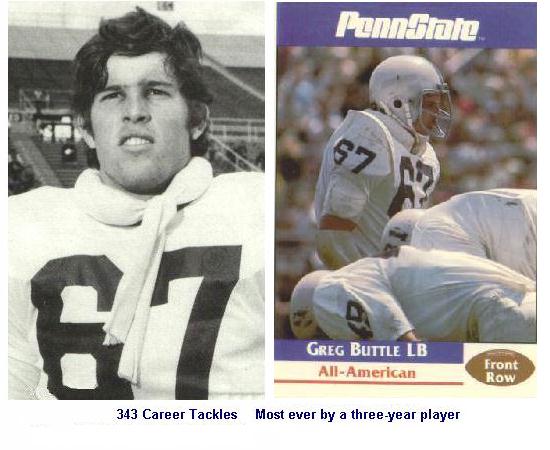
That was typical Penn State — humble, appreciative, respectful. But on the field Buttle had a legacy to maintain and showed his opponents respect only by never giving them a play off. One down at a time through his four-year career Buttle hunted down ball carries and punished them. His 165 tackles as a junior on a team that finished ranked 7th at 10-2 remain the school’s single-season record; as does his single-game high tally of 24 vs. West Virginia on October 26th 1974. His career tackle total of 343 stood as the school’s all-time record for three decades until Paul Posluszny surpassed the figure, reaching 372 in 2006 [after playing slightly more games.]

The 1974 West Virginia game typifies the spirit of Joe Pa’s greatest defenses. Standing at 2-3 Bobby Bowden’s Mountaineers were not the greatest team the Nittany Lions faced all year, but Morgantown is never an easy road trip and Penn State was never in the habit of giving opponents an easy ride whatever their record. In a hard-fought contest Paterno’s team eventually came out on top, 21-12. Three PSU linebackers kept West Virginia quite by racking up an incredible sixty-five combined tackles. In addition to Buttle’s record twenty-four, Buddy Tesner notched twenty-one while pinch-hitting backup Jim Rosecrans added twenty. It is an outstanding achievement that Buttle reached 343 career tackles on a unit in which he constantly shared stats with fellow all-conference selections and second-string youngsters capable of making twenty tackles in a game. Little wonder that he went on to a successful nine year pro career with the New York Jets. Or that the once over-awed student of Penn State’s own renaissance-man-come-football-coach should invest his time and energy after his pro career as a national spokesman for United Way.

It is utterly impossible to single out any great Penn State linebacker from the host of others. Unassuming, hard-nosed defenders made twenty tackles-a-game before Buttle in State College, and plenty have done it since. Any one of Penn State’s all-America linebackers could stand for all of the others; which I suppose is exactly why Paterno has produced so many.

One line in the PSU fight song goes: “We’ll hit that line, roll up the score…” Neither during Joe Pa’s first decade or in the nearly three full decades since has Penn State been known for rolling up scores. But Nittany Lions of the Buttle mold have hit the line down after down like no one else.


Linebacker U: search and destroy


(Sources: Keith Mano, SI; Wiki; Larry Keith, SI; ESPN Big 10 Encyclopedia; USA Today CFB Encyclopedia)

Sunday, March 14, 2010

Line it up and run it

Three minutes into the second half on a sunny late-September afternoon in 1995 at Notre Dame Stadium, University of Texas sophomore quarterback James Brown approached the ball on his own twenty-two yard line. His Longhorns trailed 13-19 after a first half featuring plenty of offense from both teams. There was plenty more to come. The exciting dual-threat Brown led his team on a seventy-eight yard scoring march to take a 20-19 lead. Texas’ defense answered with a stop to give Brown the ball back and momentum appeared to be shifting toward the ‘Horns. But after moving the ball just inside field goal range a huge sack put Texas in a second-and-seventeen situation stranded in no-man's land. On the next play receiver Justin McClemore dropped a pass that would have gained the yardage back. On third down Brown forced a careless pass toward Mike Adams and was picked off at the Notre Dame twenty-eight yard line. The Irish responded emphatically with a four play, one minute drive to the end zone that started a deluge. Randy Kinder's three-yard scoring run was the first of five Irish touchdowns in the game’s final twenty minutes. Texas managed only one sustained drive in the final period and crashed to a 55-27 defeat.

Explanations for the Texas loss were plentiful. The nation’s seventieth ranked rushing defense entered the game with its leader, defensive end Tony Brakens, suffering a fractured tibia and listed as a definite non-starter. In the event Texas head coach John Mackovic decided that with only a fifth-year senior who had never forced his way into the starting line-up to call on as backup, Brakens would have to play. Brakens ended the day with three quarterback hurries, equalling the total contributed by the rest of the defense. A unit that relied so heavily on contributions from walking-wounded could hardly be expected to contain a running back in Kindler who entered the game averaging 7.2 yards a carry. Kindler went on to finish the season with 809 yards. His fellow running back Autry Denson added 695, and fullback Marc Edwards contributed 717. This imposing three-man rushing rotation followed the lead of highly touted signal caller Ron Powlus, whose eventual season totals of 1,853 yards and twelve scores on a
60% completion rate prevented opposing defenses from simply loading the box. That backfield playing behind a solid line led by Dusty Ziegler, a senior center later drafted by the Buffalo Bills, made the Irish offense a force to be feared. Only in their opening loss, a two-point upset against eventual Big-10 champion Northwestern, did the Irish score less than twenty points all year. Little wonder that Notre Dame compiled 249 team rushing yards on 55 attempts against Texas. Powlus only threw the ball twenty-eight times, but completed sixteen for 273 yards and two scores with only one interception. Notre Dame exposed Texas’ defense. They did no less to several others before January.

The Texas defense ranked only fifth amongst Southwest Conference members through two games despite the ‘Horns having played two teams in Pitt and Hawaii that had gone 3-8 the previous season. But on the other side of the ball Texas had plenty to boast about. They traveled to South Bend ranked no worse than third in the Southwest Conference in passing, scoring, and total offense. Notre Dame defensive coordinator Bob Davie noted Brown’s 6-0 career records as a starter and praised Texas’ offensive chemistry to reporters. In his post-game interview Davie summarized his team’s preparations, saying:

“Our whole thing coming in was that we didn’t want this to turn into a track-meet.”

In the end only Texas errors prevented that outcome. Despite the lop-sided final score Notre Dame only outgained the Longhorns by ninety-yards, 511 to 422. All of those extra yards came in the final twenty minutes, aided by two Texas interceptions and a lost fumble. During the first period Notre Dame had taken a 10-0 lead on a sixty-four yard punt return from Emmet Mosley. The last points of the half came from a blocked PAT which Allen Rossum returned eighty yards. Even with those mistakes the ‘Horns might have led at the break had Brown not lost a fumble on the Irish seventeen early in the second quarter. The half ended on a high snap that ruined a field goal attempt with only three seconds remaining. Through four quarters a combined four picks, two lost fumbles, and twelve points given up or thrown away on special teams nullified the impact of over four hundred yards in offensive output.

Only one Longhorn produced a flawless performance. Freshman running back Ricky Williams carried the ball fourteen times for seventy-three yards [a 5.1 yard average] and a touchdown. In only his third game as a Longhorn Williams had yet to assert himself as the central cog in Texas’ offensive engine. Mackovic preferred to keep his game plan balanced, hoping to outsmart his opponents as much as outmuscle them. Without doubt there are times and places for clever strategy and occasional trickery in football. But more often than not, coaches establish legacies of greatness because they recruit, manage, motivate, and utilize the best talent in the most effective way. As the old adage goes, no one ever won the Kentucky Derby on a mule. Even one month into his freshmen year it was clear that Ricky Williams was a stallion. Clear to all, that is, except Mackovic.

Texas rushed the ball thirty-seven times against Notre Dame and passed thirty-seven times: perfect balance. The 'Horns gained 178 yards from scrimmage on the ground and 335 passing . Even with five sacks costing most of the team's seventy-seven negative rushing yards the passing game was not unsuccessful in terms of raw offensive output. Mackovic clearly felt confident enough to stick with his game plan. Unfortunately, he continued to do so after the tide began to turn against Texas. Brown carried a shoulder injury into the game, and though he claimed afterward to have felt no discomfort his passing numbers diminished progressively. He hit one receiver, Mike Adams, five times for 141 yards in the first half alone but failed to find him once after the break. The second half disintegration of Texas’ passing game finished symbolically on a twenty-nine yard pick-six with forty seconds left on the clock. Only twice in the second half did Texas sustain field-length drives; Notre Dame seemed to march at will. Texas held the ball almost exactly fifteen minutes during the first half, losing the time of possession battle by less than a minute. The ‘Horns also converted four of nine third downs. After the break time of possession fell to barely eleven minutes, and third down conversations fell from nearly fifty percent to less than a third at two of seven. As an offensive battle in which two ranked teams combined for nearly a thousand total yards wore on, Mackovic's balanced strategy floundered. A declining completion rate from his quarterback put his team in third-and-long situations and resulted in turnovers.

After the game Lou Holtz praised Ricky Williams and stated that if he had the use of such a talented back he would put the ball in his hands just about every down. In fact that is basically what Holtz did with the perfectly capable backs in his own stable. Notre Dame ran the ball fifty-four times against Texas for 249 yards, passing only twenty-eight. The Irish ran wild, riding their option attack to an absolute rout. But there was no good reason Mackovic couldn’t have answered in kind.

Williams left UT after his senior season with a Heisman Trophy and as the NCAA all-time rush leader after surpassing Tony Dorsett’s twenty-two year old record of 6,082 yards by nearly two-hundred. It took Mackovic a surprisingly long time to give Williams the touches his performances demanded. After his first three games as a Longhorn Williams had carried the ball 38 times, a 12.6 carry-per-game average. His season total finished at only 12.7 cpg, despite his impresive yard-per-carry rate of nearly six on 166 rushes for 990 yards. As a sophomore he rushed 205 times for 1,272 — fifteen times a game for a 6.2 average. As a junior those figures increased 1,878 on 279 carries — twenty-five carries a game for a 6.73 average. That season Texas squandered a plethora of talent to somehow finish 4-7. Mackovic was duly fired and replaced with North Carolina head coach Mack Brown. In Brown’s first season Williams saw the ball 361 times [over thirty times per game], 2,124 yards [a 5.9 yard average], and won the Heisman.

Players generally improve with time and entrusting freshmen with too much responsibility is not often wise. But Ricky Williams was no ordinary freshman. His yard-per-carry rate remained steady around a highly impressive six from begining to end of his collegiate career. Williams was almost certainly as ready for thirty touches a game in his freshman campaign as he was when Mack Brown arrived in Austin three years later. Unfortunately for Texas fans, and ultimately for the man himself, Mackovic apparently lacked the vision or the courage to make a choice that seems simple in retrospect. His is a depressingly familiar cautionary tale of a coach out-thinking himself in an effort to employ the most innovative strategy.

Lou Holtz had the right idea. Even if you hand the other team your playbook, they still have to actually stop your guys.


(Sources: USA today CFB encyclopedia; Fort Worth Star-Telegram; Dallas Morning News; CFB data warehouse; Texassports.com)

Sunday, March 7, 2010

Coaches and the culture of Notre Dame, part 2: "He's running what?!"

During April of 1930 Notre Dame head coach Knute Rockne and would-be senior tackle Frank Leahy spent two bed-ridden weeks side-by-side in the Mayo Clinic. Rockne had missed much of the 1929 season due to several health issues including a leg ailment. Despite Rockne’s partial absence, his finely-tuned and thoroughly prepared team went undefeated and earned his third national championship. Leahy, a three-year letterman, hoped to contribute to a fourth championship as a senior. Unfortunately he badly injured his knee during spring drills, ending his playing career. Leahy was only average in size but always showed an iron will on the field, playing with an aggressive determination that caught the attention of his coaches. His mind for the game certainly impressed Rockne. As the two men convalesced, Leahy questioned his coach on every aspect of the game, picking his brain for knowledge and insight. Recognizing the young prodigy’s passion and latent talent, Rockne named him a student assistant coach the following season — a repeat national championship campaign.

Leahy was enamored of Rockne’s ability as a coach. He well knew the value of his coach’s experienced views on motivation, alumni relations, player management, tactics, and any number of other topics. But Leahy also possessed a self-assured confidence in his own abilities. As he grew into his own coaching career he did not become a slave to the Rockne mystique. Eventually that helped Leahy to be the first of only a handful of Notre Dame coaches to live with any measure of success in Rockne’s shadow.

After graduation Leahy spent a decade as a line coach, first at Georgetown and Michigan State, and at Fordham from 1933 to 1938. Fellow Notre Dame alumnus Jim Crowley [one of the famed four Horsemen] led some great Fordham teams in the later thirties that were noted for their fierce line play. While in New York, Leahy also passed the Rockne coaching torch on to future NFL legend Vince Lombardi, one of his most outstanding linemen. By 1939 Leahy’s resume was strong enough to earn a head coaching position at Boston College. Leahy wasted no time in leading the Eagles to their first ever bowl appearance, a narrow loss in Dallas' Cotton Bowl to Clemson. The following year Leahy's team went a perfect 11-0, claiming a national championship by beating General Robert Neyland’s Tennessee Vols in the Sugar Bowl. Boston College would not win another championship of any form until 2004.

While Leahy was busy leading the Eagles to preeminence in the East, his alma mater was enjoying far less notoriety under eighth-year coach Elmer Layden. Seven successful seasons with an overall win percentage of .724 at sister Catholic school Duquesne seemed to qualify Layden as successor for the disappointing ‘Hunk’ Anderson. His credentials as a noted former Rockne player didn’t hurt, either — Layden was another former horseman. Unlike the unpopular Anderson, Layden was likeable. He maintained good alumni relations and promoted the school’s image tirelessly. He even managed to heal a rift with the University of Michigan over scheduling that had lasted more than twenty years. Perhaps more importantly, Layden gave Notre Dame backers what they expected by continuing Rockne’s offense and offering virtually no innovations of his own.

"Outlined against a blue-grey October sky, the Four Horsemen rode again." Layden is first on the left.

Layden’s approach was hardly a disaster. After his initial 6-3 campaign his teams never lost more than two games in a single year. He stepped down after the 1940 season with a solid .726 win percentage. Layden's teams rarely lost to Notre Dame’s principle rivals [Army, Navy, and USC]. But making few mistakes is, unfortunately, not the right formula for succeeding Rockne. Layden’s tactics were cautious and outdated. While the talent available at Notre Dame and solid execution of fundamentals could carry any Irish team past most of the opponents on their annual slate, good coaching from more innovative opponents caused serious difficulty. In his final season Layden’s team reached 7-0 and earned undeserved acclaim before finally coming unstuck at home against Iowa in mid-November. Even without 1939 Heisman winner Niles Kinnick [who had entered the navy as a pilot] Eddie Anderson out-coached Layden, leading his Hawkeyes to a one-touchdown upset victory. The following week Notre Dame lost 20-0 at Northwestern and Layden began to feel enormous pressure. Finishing the season with a road win at Southern Cal did not prevent university vice-president Father John Cavanaugh from listening to rumbles of discontent emanating from influential ND backers. Immediately following the season Cavanaugh sent Layden’s assistant Chet Grant on a scouting mission to New Orleans.

Grant observed the Boston College Eagles in practice and attended the Sugar Bowl. Despite his position as assistant coach Grant only wanted the best for his alma mater and recommended that Cavanaugh hire Frank Leahy. Knowing it would cost him his own job, Grant reported:

“Boston College out-smarted, out-charged, out-stayed probably the best team in the country in as well-played a game as I ever saw. Boston College showed me things I didn’t think could be done… I became convinced that Leahy is a coach of destiny.”

Grant was right on two counts. He did lose his job when the new staff came in to South Bend, and Leahy was indeed a coach of destiny. His eleven seasons at ND brought in four national championships. Leahy retired after the 1953, utterly exhausted by his frenetic perfectionist approach, with a head-coaching record of 107-13-9. His win percentage of .864 remains second only in the history of college football to the .881 mark of Knute Rockne himself.

Leahy’s first season was an unbeaten campaign blemished only by a scoreless tie with Earl Blaik’s Army Cadets. The gifted, indefatigable and soon-to-be legendry coach gave every indication of his ability to live-up to Rockne’s legacy. Fans, alumni, and boosters voiced their confidence and joy. But that goodwill and the credit earned in an undefeated freshman season garnered seemed to evaporate when word leaked that Leahy intended to sacriligiously discard the ‘Notre Dame Box’ offense the following season. During spring practices Leahy began work on installing the new T-formation, used to great effect by the Chicago Bears in their stunning 73-0 destruction of Sam Baugh’s heavily-favored Washington Redskins in the 1940 NFL championship game.

The Box was Rockne’s variation on the “shift” scheme engineered by the original football innovator Amos Alonzo Stagg. The story of the shift reads like a star-studded overview of the early history of football. The system revolved around a series of pre-snap backfield movements decided at the line of scrimmage according to what the offensive signal-caller saw from the defense. Stagg was nothing if not creative. As a leading member of the collegiate game’s rule committee he was quick to embrace the new forward pass in 1906, drawing up a host of new plays to the delight of his University of Chicago coaching staff. Jesse Harper, a young graduate assistant, learned Stagg’s new scheme and took it with him to Notre Dame when he became head coach there in 1913. The game’s East Coast establishment and press were always more conservative than Stagg and remained skeptical toward the forward pass. Harper shattered that conservatism one historic day in Yankee Stadium. He spent his first pre-season in South Bend practicing forward pass plays with his backfield starters. On November 1st 1913 Notre Dame travelled to New York and stunned a highly-rated Army team, winning 35-13 on the strength of several deep passes from Gus Dorais to Knute Rockne. Later as Harper’s assistant Rockne adjusted Stagg’s shift patterns, dropping the halfback a few feet from the line's unbalanced strong-side to a more flexible backfield position. In Rockne’s system the four backs lined up in a square [or 'box'] pattern and could shift quickly to pass or run to either the strong or weak side. This system was complex, requiring excellent coaching and rigorous practice. Notable Irish alums who learned the Box playing for Rockne included Culry Lambeau, the founder and inaugural coach of the Greenbay Packers, and Frank Thomas, the Wallace Wade's heir at the University of Alabama. Thomas coached several greats at Alabama, including the young Paul “Bear” Bryant and his teammate Don Hutson, who set numerous NFL receiving records out of the Box system playing for Lambeau’s Packers.

Rockne’s tactical scheme saw widespread success and was clearly endorsed by some eminent football greats. Little wonder therefore that no one at Notre Dame thought about changing philosophy for more than a decade after his death. Even while complaining of Layden’s increasingly ineffective, predictable and stodgy teams, no one in South Bend seemed to view the system as the problem rather than the man. The truth was that, like all systems, the box offense had a limited lifespan and inevitably good defenses caught up. It took a man possessed of Leahy’s vision and iron will to see that fact and act accordingly.

In the new-fangled T-formation Leahy’s Fighting Irish opened the year with a 7-7 tie at Wisconsin before losing their home-opener to a Georgia Tech team that eventually finished an unimpressive 3-6. Critics willing to double-guess Leahy came out in droves to howl at his foolish audacity in adopting an unproven offense. Backers clamored for a return to “Notre Dame football” and the following week, despite a convincing win over Stanford, Leahy checked into the Mayo Clinic suffering from “extreme nervous tension”.

Naturally Leahy’s critics disappeared after Notre Dame won a national championship the following season. By the time he retired Leahy had cemented an unquestionable legacy of coaching greatness. Furthermore, the T formation had surpassed Glenn “Pop” Warner’s ‘Single Wing’ variation on Stagg’s shift as the most widely used offense system in football. No doubt few if any of Leahy’s conveniently forgetful critics ever publically ate any humble pie.

Following another disappointing 6-6 season in 2009, Notre Dame parted ways with Charlie Weis. They replaced him with Brian Kelly, erstwhile head coach of the University of Cincinnati Bearcats. Kelly is an unapologetic devotee of pass-first variations of the spread offense. Recent Notre Dame teams have struggled with numerous problems, but among the more prominent and painful to watch has been an embarrassing inability to run the football. No small amount of nay-saying skeptics on Irish internet chat-boards — which are rarely noted as gathering places of rational, far-sighted individuals — are asking whether Kelly’s scheme is the best way forward for an offense that already can’t run five yards against Powder Puff defenses.

Pass-first spread offenses aren’t my personal cup of tea, and there are plenty of reasons not to like Kelly's system; but the man's resume isn’t one of them. After two decades as a head coach and two upward moves to higher level jobs Kelly owns a .747 win percentage with an overall record of 171-57-2.

My money is on an Irish revival.


Friday, February 12, 2010

Coaches and the culture of Notre Dame, part one: "you're fired!"

When Knute Rockne took over as head football coach at Notre Dame in 1918 the Fighting Irish were a non-entity compared to the more prominent Western [Big Ten] Conference programs of the region's Protestant-controlled state universities. The league would not permit a Catholic school to join, and often its members would not even play Notre Dame. Until the tenure of Rockne’s immediate predecessor Jesse Harper, no coach had served more than three seasons or twenty games. Notre Dame had a football team, not a program. By the time of his untimely death in March 1931 Rockne had solved Notre Dame’s scheduling problems, built a new stadium, developed a lucrative national fan-base, created a lasting ‘brand’ image, and won 105 football games. He had given the men of South Bend a taste for success and set the bar of achievement very high. So high, in fact, that no division one coach has surpassed his .881 career winning percentage in going-on eighty years.

Rockne inherited many problems when he assumed his role as Notre Dame football coach and athletic director. He left an entirely different set behind him. One of them, every single one of his successors has grappled with every single day on the job: the pressure of sustaining a winning tradition. “Success breeds success” is an old platitude that carries some truth. Even truer is that success breeds the demand for success. At Notre Dame it has also bred a rather unpleasant culture of ousting unsuccessful Rockne successors.

Everyone knew following Rockne would be a nearly impossible task. The man had become a larger-than-life figure, admired and adored nationally. When university president Father Hugh O’Donnell asked Jesse Harper to return to South Bend he consented only to assume the role of athletics director, steering clear of any coaching responsibility. Regardless of the obvious pressures there were several candidates understood to be interested in the job. Some already had head coaching experience elsewhere, but the Notre Dame priests were as insular and snobby in 1918 as they can be today. Frank Thomas was overlooked because Alabama was considered a backwater, insufficient to prepare a coach for Midwestern football. That was surely a mistake.

In the end the job fell to Heartley “Hunk” Anderson, Rockne’s assistant. Hunk had played as a lineman on Rockne’s earliest ND teams, though somewhat undersized at 170lb – even for 1918. A five sport letterman, Anderson was extremely athletic and very talented. Hunk came to Indiana from Michigan because of a hometown friendship with the now legendary George Gipp. His years as a player were the first great era of Irish football, the school lost only two games in his four seasons. He went on to play several years with the Chicago Bears before returning to South Bend as an initially unpaid assistant coach in 1927. Hunk had passion, commitment, a desire to win, a love of the game, and no end of athletic aptitude. He was not at all a poor choice as head coach, at least on paper. Unfortunately he lacked Rockne’s affable charm – but then, who doesn’t?

Rockne had insisted upon complete control of the athletics department, books and all. He could always find grant-in-aid scholarships for his players and maintained a large roster. When Anderson assumed the role Notre Dame Vice-president Father Michael Muclaire made clear that the new era would be different. The priests would subject athletics programs to complete institutional oversight. Anderson enjoyed the same basic amount of scholarship packages from the school that Rockne had been given. What he failed to do was maintain the network of unofficial booster relationships that Rockne had established to provide off-campus jobs for ND players. That system enabled Rockne to take on more and better players, but on Anderson's watch the gravy-train dried up.

The same bullish lack of charisma that inhibited Anderson's efforts at glad-handing boosters also made him a less capable motivator of players. He had always been the aggressive task master as assistant and filled the role admirably. But a head coaching job requires much more. Managerial skills, media relations, giving players a sympathetic ear, inspiring respect, motivating deeper effort… These roles are not new to modern head coaching culture. Hunk did not change the tactics or philosophy that he and Rockne had successfully employed on the field. He stuck with the famous “box” offense, built around controversial multiple-player pre-snap shifts. Anderson knew this system as well as any living man. He could coach it and had done so. His teams did not lack talent. That showed in the fact that they routinely beat the lesser opponents that Notre Dame teams were supposed to beat. But occasional performances began to lack luster. Inevitably, unacceptable losses followed.

Anderson’s career as head coach opened with a 25-0 romp over a useless Indiana team, but questions were raised the following week when the Irish played out a thoroughly uninspiring 0-0 tie against Northwestern at Soldier Field. Following that performance with four wins over lesser teams failed to convince the most powerful newspapers. After a 20-0 win over a comparatively poor Navy side in Baltimore on November 14th one Eastern journalist complained that:

“A stern and fearless [boxing] fight commission with the honor of the grand old game at heart might suspend them for not trying…”

Notre Dame was then 6-0-1, a good record. Anderson was a first-year head coach. The walking legend who had built the program from nothing had died tragically less than a year previously, leaving the team in shock. Wouldn’t it be reasonable to expect a little grace? But reasonable and the measure of expectation that comes with being Notre Dame football coach had about as much to do with one another in 1931 as they do today. Hunk received no grace.
The following week USC visited South Bend. A crowd of 52,000 watched Anderson’s team control the first three quarters and reach the forty-five minute mark up 14-0. Early in the final period USC began to build momentum but Anderson, not perceiving the shift, pulled many of his first string players. Under one-platoon substitution rules they could not be returned to the game that quarter. Notre Dame’s best players watched helplessly as the Trojans surged to a 16-14 comeback win, sealed on a scoring drive sustained by a reckless penalty that blew a Notre Dame defensive stand. In the final fifteen minutes the Irish had committed errors, relinquished the ball weakly, been out muscled at the line of scrimmage, and fallen foul of a sucker trick-play. Notre Dame had been out coached. Rockne’s teams lost games, sometimes. But they were never out coached, ever.

The 1931 season finished with a 12-0 road loss at Army. One newspaper reported that Notre Dame had so been so utterly inept on offense that Irish coaches suspected Army of knowing their signals. In fact the play-calling was predictable enough that knowledge of the signals was unnecessary. Whispers of Hunk’s inadequacy began, even after one season with a not unrespectable 6-2-1 finish. Rumors were strong enough for the campus newspaper to openly acknowledge. The Scholastic reported that Hunk would stay on, making a point in Anderson’s favor that would be repeated many times for many coaches in future years, regardless of the argument’s relevance:

“Hunk Anderson is a Notre Dame man.”

By the time the following season began Anderson could feel the weight of expectation resting heavily upon him. Once again the schedule provided very few chances to truly prove Notre Dame’s worth. Three wins over Haskell Institute, Drake, and Carnegie Tech by a combined score of 177-0 meant very little and impressed no one but the ever enthusiastic student body. The seemingly surging Irish came unstuck in their fourth game, at Pittsburg. Two interceptions returned for scores in a single minute gave Pitt a 12-0 lead. They held on and late in the game the Notre Dame offense that had scored so freely against minnows looked frantic and clueless. An AP writer described the “strange” sight:

“A Notre Dame team, its assurance and cohesion absolutely destroyed, passing wildly like a bunch of high school kids in a demoralized effort…”

Newspaper exaggeration and speculation abounded to the point that now Jesse Harper had to explicitly address the situation. He told reporters that Anderson would be coaching at ND the following year:
“The fact that he lost one game is no reason to fire him. We at Notre Dame feel he has done a fine job.”

On the face of things there was every reason to agree with Harper’s statement. The Irish answered the Pitt loss with four wins over Kansas, Northwestern, Navy, and Army, giving up only a single touchdown. The Army win, at Yankee Stadium, was particularly impressive. One newspaper called the display “dazzling”. Notre Dame’s countless New York ‘subway alumni’ were thrilled. But the mood did not last. Again Anderson’s team finished the year on a loss, and a most inopportune one. Two weeks and three-thousand miles of rail travel after beating Army in New York the Irish faced USC in Los Angeles. 93,000 came out to witness a dominating physical display up-front from the Trojans, who won handily 13-0.

Over the year Notre Dame had racked up 540 penalty yards against 245 by their opponents. That was sloppy play, even when they were winning. Anderson couldn’t seem to keep referees on his side. He apparently didn’t care about winning the press over, either. After the USC loss he gave only a single interview to one paper, angering a host of Midwestern beat writers who had travelled 2,000 miles to cover the game. Francis Wallace, an influential writer who had always vocally backed Rockne’s Irish, complained that Notre Dame was “learning to lose.” Four losses in two years were, he said, not acceptable in South Bend.

Going into the 1933 season Notre Dame had never fired a football coach. One might be forgiven for thinking that a man with a record of 13-4-1 could hardly be considered a candidate for setting that precedent. And yet the tension around Anderson was palpable. One prominent Irish-Catholic priest wrote in his widely read column that Notre Dame football was “a spiritual service played for the honor and glory of God and his Blessed Mother.” This magnitude of sentiment did not seem overstated to many Notre Dame backers. So when Hunk prohibited visiting priests from watching pre-season practices without letters of clearance from their bishops, the move naturally created a bitter reaction. Most wondered what of such secretive importance had gone on in those practices when the Irish opened with a pathetic 0-0 tie against Kansas. Notre Dame had won its season opener every previous year since 1901.

Only one game into the season Anderson’s uninspiring personality and his team’s poor play had already turned even the home press against him. The South Bend Tribune editorialized:

“This fellow Anderson may be a coach, but if he is, I’m ready to accept my post as ambassador to China.”

An anonymous open letter signed by “an irate fan” and dated the day after the Kansas game ran in several papers. It began:

“There is no disgrace in failure. There is disgrace in sticking through when one sees that he has not measured up.”

Such audacious, irreverent attacks from ordinary fans were par for the course. Rockne had built his success on making Notre Dame the ultra-accessible, globe-trotting team of the huddled masses. He welcomed the sentiment that poor, uneducated, immigrant Catholics possessed a meaningful sense of ownership in his program. With Rockne as coach that ownership only ever took the form of adulation and vicarious enjoyment of ‘their’ team’s success. Rockne never lived [and likely never would have lived] to see that sense of ownership become a problem. But as so many coaches can confirm, the cheers of the emotionally invested turn very quickly to jeers when results begin to waver.

Results did waver. In 1933 Anderson’s team began losing not only crucial games to good opponents, but many games to mediocre one. Losses to Carnegie Mellon, Pitt, Navy, and disdained in-state step-sister Purdue were unacceptable. As was a third straight loss to Southern Cal. By the season finale in Yankee Stadium vs. 8-0 Army Anderson seemed like a dead man walking. To the surprise of all, ND won a field-position battle on a late, late Army punt that was blocked in the endzone for a touchdown. New university Vice-president Father John O’Hara’s praise of the comeback as “a thrilling exhibition of old-time Notre Dame football” sounds to modern ears like the dreaded Board of Trustees ‘vote of confidence’. The fact remained, 13-12 comeback win or no, that Notre Dame had finished 3-5-1: the school’s first losing season since it had played Michigan three times and lost all three in 1887 – its first year of football.

The following week the university announced that both Harper and Anderson had ‘resigned’. Hunk’s position was untenable and he could not have stayed had he desired to do so. Notre Dame had pushed a football coach out of the door for the first time in its history. The man was an alumnus, a celebrated letterman, a former Rockne assistant, and a childhood friend of George Gipp. Anderson could not have been more of “a Notre Dame man”. More importantly, [if being a ND man is important to coaching in South Bend at all] his record over three seasons was a reasonably respectable 16-9-2.

On November 30th, 2009 Notre Dame fired Charlie Weis after a more generous five seasons and with a far less respectable record of 35-27. The university paid him the ungodly $18,000,000 remaining on his ridiculous contract just to get him out of South Bend. Many harsh words were said by fans, media, and general passers-by regarding Weis’ performance. The disgracefulness of “sticking through when one sees that he has not measured up” was oft commented upon. In stark mockery of the chest-thumping promises made at his 2005 introductory press conference, Weis ended as just the latest in a long line of coaches to learn that it is very, very difficult to succeed Knute Rockne.
Even after eighty years.


(Sources: Murray Sperber, Shake Down the Thunder -- Sperber's book is the exhaustive, definitive, must-read resource for the early history of ND football. It is a peerless achievement.)