Thursday, April 29, 2010

Great defensive players: Greg Buttle

Joe Paterno has defined Old School football for so long that no one can remember when he was just School. Through the first ten years of his head coaching tenure in State College his Nittany Lions enjoyed the nation’s best overall record. Better than Woody Hayes’ Buckeyes, or Bob Devaney and Tom Osborne’s ‘Huskers. Better even than The Bear’s Crimson Tide. Because no one could ever argue with Paterno’s result they never criticized his methods either. The no-name, plain-uniform program still has a behind-the-times feel today, even in the almost universally stodgy Big Ten. But Paterno wasn’t any more up-with-the-times in 1975 — except that he won, and winning is cool.

Penn State did not have an athletic dorm. Paterno always worked hard first and foremost with all his recruits to sell the school and the collegiate experience. He told one Sport’s Illustrated reporter that he considered a home visit by a football coach to be “just about the worst” reason to select which university to attend. When young men visited campus Paterno often sent them out to wander around campus alone, and always insisted on academic meetings with faculty members in their prospective departments. Paterno wanted boys to want to attend Penn State, but not in the way that most football coaches want boys to attend their school. Joe Pa cared, and still does care, that his players truly sucked the marrow out of college life. For that reason he was outspokenly opposed to the NCAA’s 1972 decision to repeal its prohibition on freshman eligibility. Paterno’s view of the injustice of that move sounded out-dated and wildly idealistic even then, having more the ring of English professor than head coach about it:

“There's so much besides football. Athletes who come to Penn State shouldn't be tied down to a football program. These should be the four greatest years of their lives. I tell them, 'Enjoy yourselves.' I consider football an extracurricular activity, like debating or the band. It should never be removed from that context. More than 90% of our players graduate on schedule.”


Still enjoying it...


That was always Paterno’s way. Somehow his Nittany Lions won ball games without cheating, cutting class, or showboating. The “noble experiment” Joe Pa began in 1966 worked — spectacularly. And it worked not only because Paterno believed everything he said about fun, the college life, learning, attitude, and a host of other subjects, but also because he loved winning football games as much as any peer. Whatever he told reporters.
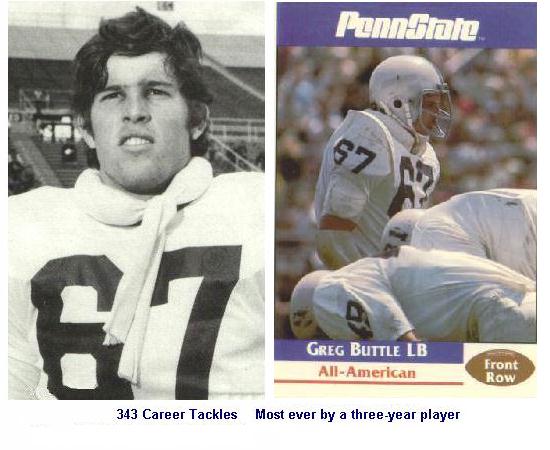
The archetypal Penn State football player would be workmanlike, diligent, unassuming, intelligent, well rounded, and quietly effective on the field. And he would surely be a linebacker. Call him Greg Buttle.

If Joe Pa’s offenses opened few eyes and his philosophy on college life seemed almost medieval, his defenses made up for it by setting plenty of trends. Penn State was one of the first college programs to run a 3-4 base defense and the four-man linebacker corps at the unit’s center was characterized by remarkable lateral mobility. Big enough to come up and crush the healthiest of running games, smart enough to read offenses on the fly, and fast enough to drop into coverage in an instant; Penn State’s linebackers seemed to simply emerge in an unbroken line of succession from a single mold. Unsurprisingly for a man who sixty years after his graduation is still tied for the all-time interception record at his alma mater, Brown, Paterno has always had an eye for defensive talent. And character. Penn State coaches didn’t just retool their linebacker unit year after year with the previous fall’s most highly touted prep all-American. They frequently converted players from other positions. They also insisted that recruits pass the attitude test. Current players reported back to coaches on recruits after visits and scholarships were often withheld solely on the strength on a player’s opinion that a prospective recruit would not fit the program.

That screening process produced five consensus all-America selections for Penn State linebackers through Paterno’s first ten seasons: Dennis Onkotz twice in 1968 and ‘69, Jack Ham [a High School Offensive Guard] in 1970, John Skorupan [a former receiver] in 1972, and Greg Buttle [another former receiver] in 1975. Some of Paterno’s great ‘backers were bigger than average, some smaller. Some had played the position before, some hadn’t. That didn’t really matter. Joe Pa himself seems a misfit. An Ivy League literature student who has consistently refused pay raises in an era of ever-escalating coaching salary arms races and used no small amount of the money he has earned to partly fund the school’s library [which appropriately bears his name.]

In a profession dominated by maniacal type-A personalities Paterno is a relative renaissance man. It is quite fitting therefore that the defenses that carried his teams should have been built around young men like Greg Buttle. In addition to his outstanding football prowess Buttle was also an active Barber Shop Quartet singer and a sufficiently successful ocean rower to eventually earn enshrinement in that pastime’s Hall of Fame. For all his accomplishment, Buttle remained the consummate Penn State man and never developed an inflated ego. Paterno used to encourage his players to call him “Joe.” Like most of them, Buttle couldn’t bring himself to do so. He continued to bashfully call the living legend “Coach Paterno.” Joe Pa jokingly responded by routinely addressing his all-America linebacker as “Player Buttle.” Shortly before entering the NFL as a third round draft pick by the Jets in April 1976 Buttle joked to a reporter that he had been overwhelmed by his head coach as a young player.

“In my freshman year I never talked to him. I saw him in his shorts one day. I thought, Joe Paterno in shorts. It was like seeing a god in shorts.”

That was typical Penn State — humble, appreciative, respectful. But on the field Buttle had a legacy to maintain and showed his opponents respect only by never giving them a play off. One down at a time through his four-year career Buttle hunted down ball carries and punished them. His 165 tackles as a junior on a team that finished ranked 7th at 10-2 remain the school’s single-season record; as does his single-game high tally of 24 vs. West Virginia on October 26th 1974. His career tackle total of 343 stood as the school’s all-time record for three decades until Paul Posluszny surpassed the figure, reaching 372 in 2006 [after playing slightly more games.]

The 1974 West Virginia game typifies the spirit of Joe Pa’s greatest defenses. Standing at 2-3 Bobby Bowden’s Mountaineers were not the greatest team the Nittany Lions faced all year, but Morgantown is never an easy road trip and Penn State was never in the habit of giving opponents an easy ride whatever their record. In a hard-fought contest Paterno’s team eventually came out on top, 21-12. Three PSU linebackers kept West Virginia quite by racking up an incredible sixty-five combined tackles. In addition to Buttle’s record twenty-four, Buddy Tesner notched twenty-one while pinch-hitting backup Jim Rosecrans added twenty. It is an outstanding achievement that Buttle reached 343 career tackles on a unit in which he constantly shared stats with fellow all-conference selections and second-string youngsters capable of making twenty tackles in a game. Little wonder that he went on to a successful nine year pro career with the New York Jets. Or that the once over-awed student of Penn State’s own renaissance-man-come-football-coach should invest his time and energy after his pro career as a national spokesman for United Way.

It is utterly impossible to single out any great Penn State linebacker from the host of others. Unassuming, hard-nosed defenders made twenty tackles-a-game before Buttle in State College, and plenty have done it since. Any one of Penn State’s all-America linebackers could stand for all of the others; which I suppose is exactly why Paterno has produced so many.

One line in the PSU fight song goes: “We’ll hit that line, roll up the score…” Neither during Joe Pa’s first decade or in the nearly three full decades since has Penn State been known for rolling up scores. But Nittany Lions of the Buttle mold have hit the line down after down like no one else.


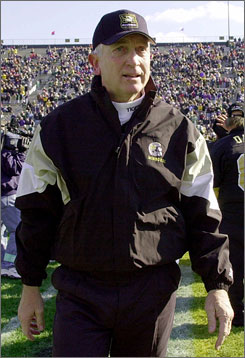
Linebacker U: search and destroy


(Sources: Keith Mano, SI; Wiki; Larry Keith, SI; ESPN Big 10 Encyclopedia; USA Today CFB Encyclopedia)

Saturday, April 17, 2010

Great defensive players: Ricky Hunley

When Larry Smith, a Bo Schembechler disciple, took over as head football coach at the University of Arizona in 1980 he inherited a program that had earned only two shared conference titles since WWII (both in the WAC), had never won a bowl game, and had finished in the AP poll only twice. Smith was not a high-profile candidate. Through the first three of his four seasons at Tulane he had won only seven games. But then, Arizona was not a high profile job. Preparing for its third season in the newly expanded Pac-10 Conference Arizona had been invited for its size, geographical location, and perhaps its basketball program. Smith’s mandate was for solid, steady progress. He approached that mandate with a passion for the game, wearing his heart very much on his sleeve. He became emotionally invested in the University, eventually retiring in Tucson even after several subsequent head coaching stints elsewhere. Smith also invested in his players.

After his death in 2008 former Arizona linebacker Lamonte Hunley told the USA Today that Smith was extremely careful to listen to parents on recruiting visits. He spent time discussing the family’s goal for their child and whether Arizona was a good fit for those goals. He also promised to make football in Tucson fun; a promise Hunley believed he invariably kept. That approach allowed Smith to recruit a slightly better class of talent than previous ‘Zona coaches had managed. And with that talent he fulfilled his mandate for steady progress, improving his team’s record in each of his seven seasons. The Wildcats progressed from 5-6 in 1980 to 9-3 and the school’s first ever bowl win in 1986.

Smith worked hard recruiting players from across the West and nationally. Most were a modest upgrade for the program. Some were genuine first-class athletes such as slot back/punt returner Vance Johnson who was NCAA Long Jump champion in 1982. But in seven seasons of impressive progress Smith produced only one true great and consensus all-American — Lamonte Hunley’s older brother Ricky.

Ricky was no surprise as a collegiate star. His multi-sport performances as a Prep athlete in his hometown of Petersburg, Va. earned him attention from baseball scouts and he was drafted by the Pittsburgh Pirates. But as Hunley grew bigger and stronger it became increasingly clear that his best chance for a successful athletic future lay with football. At the time Virginia’s state schools were hardly successful football powers. Playing outside of the home turf of college football’s great programs Hunley did not garner quite the attention he might have received growing up elsewhere. This allowed Smith to pull off his greatest coup as Arizona head coach and bring Ricky to Tucson.

Hunley lettered four years as a bruising Inside Linebacker in Arizona’s 3-4 base defense. He entrenched himself permanently in the starting lineup only part way into his freshman season with a fourteen tackle performance versus UCLA, four behind the line of scrimmage. Standing at 6’2” with a playing weight of around 230 lbs Hunley was not freakishly big or even outstandingly quick for a college athlete. But his natural athleticism, ability to read the game, and continual desire to learn enabled him to rise above other players with similar or greater physical gifts. By the end of his junior season Hunley had amassed 224 career solo tackles and 166 assists, becoming his school’s first ever all-American in 1982.

As a senior Hunley added ninety-nine more solo tackles, seventy-seven assists, ten tackles for loss, five interceptions, five forced fumbles, three fumble recoveries, and repeated as a consensus all-America selection. Hunley terrorized opposition backfields and earned all-conference honors in each of the three years he started. After graduation Hunley was taken seventh overall in the 1984 NFL draft by the Cincinnati Bengals. When the young star’s agent presented a thirty-page proposal listing contract demands the organization felt were excessive a hold-out ensued. Eventually the Bengals traded Hunley to Denver for first and third round picks in the 1986 draft and a fifth round pick in 1987. Hunley’s starting deal of $1 million over four seasons, a $1.75 million signing bonus, and $60,000 of incentives caused enough of a splash to initially alienate several less well-paid Bronco veterans. But he eventually proved a sound investment, leading a solid defense that more-than supported John Elway’s offense en route to consecutive AFC championships in 1986-87. [Elway was certainly much happier watching Hunley from the sidelines as a Bronco than he had been running from him in Stanford’s backfield as a collegian.]

The Wildcat team he led as a senior started the season an unprecedented #14 in the AP poll and climbed to #3 after a 4-0 start — still the highest spot the school has ever reached. After reaching 5-0-1 three straight losses sent ‘Zona crashing out of the polls before two wins to finish the season salvaged some respect. Commentators believed the team failed to handle unfamiliar pressure at the business end of the polls. That was doubtless part of the 1983 Wildcats’ problem. But more importantly the position Smith’s team reached in week five was probably about as high as a team can reach with only one true all-American on the field. Defense is supremely important in football, though defensive stars are too easily forgotten. The fact is that an otherwise only modestly good team can achieve just about anything short of major championships with a 120 tackle-a-season linebacker like Ricky Hunley between the hash marks.


(Sources: USA Today, Larry Smith obituary; SI, 1983 Pac-10 preview; CFB Hall of Fame; USA Today CFB Encyclopedia; Bob Hill, Miami Sun-Sentinel; APpollarchive.com;

Saturday, April 3, 2010

Great defensive players: Charles Smith, George Webster, and Charlie Thornhill

On a chilly, hostile November afternoon in East Lansing at the end of the 1966 season Coley O’Brien walked toward the ball at his own thirty-yard line. With a minute remaining, a keenly anticipated meeting between unbeatens No.1 Notre Dame and No. 2 Michigan State was tied at 10-10. Offensive mistakes on both sides had given opportunities that imposing defenses had staved off, including a first quarter Spartan fumble on their own four-yard line that produced no points for the Irish. With sixty seconds to play and seventy yards to go the football gods had given Notre Dame one last chance, but Ara Parseghian decided controversially not to take it. The Spartan defense lined up expecting a deep ball. When O’Brien handed off for two consecutive short-yardage running plays without any apparent urgency reality dawned on the now disgusted Michigan State players. As a cacophony of boos rained down from the stands Spartan defenders added their own insults and taunts.

Senior Defensive End Charles “Bubba” Smith yelled: “Come on, sissies.”

Linebacker George Webster shouted across the line of scrimmage to the Irish players in their huddle: “You’re going for a tie aren’t you? Get of the field, you’ve given up!”

Parseghian calculated correctly that Notre Dame’s prestige and polling power would deliver a national championship despite the school’s policy of refusing bowl bids and a record blemished with a tie. Sports Illustrated writer Dan Jenkins led the charge of outraged journalists lobbying for pollsters to “punish” Notre Dame. Jenkins sarcastically wondered whether Parseghian had exhorted his players to “Tie one for the Gipper!” But appeals for AP voters to bestow the title upon Bear Bryant’s Alabama after the Tide dismantled Bob Devaney’s Cornhuskers in the Sugar Bowl fell on deaf eras. Notre Dame’s emotional grip on football pollsters could not be broken. That fateful game in Spartan Stadium on November 19th 1966 has been defined in football lore and memory ever since by Parseghian’s somewhat cynical and certainly ignoble calculation. The unbeaten Spartans somehow got lost in the story, playing only the role of unmemorable dancing partner to the real actors from South Bend.

The outcome of that game and its subsequent place in college football history is highly lamentable. November 19th 1966 would more rightly be remembered as the last game of two incredible seasons for the best ever Michigan State defense. Smith and Webster, two time all-Americans of outstanding pedigree, should have finished their careers in East Lansing as they had spent every preceding minute — hustling like the hounds of hell and running over helpless opponents in pursuit of victory. Instead, Parseghian’s conceit and the Big Ten’s nonsensical prohibition of repeat Rose Bowl performances forced the Spartan stand-outs to play end their years in the collegiate game on a low note of anger and frustration.

The 1965 and 1966 seasons remain the high watermark of Michigan State football history. Had the home fans known that November that more than forty years later they would still be awaiting a second performance as repeat Big Ten champion they would probably have rushed the field looking for blood. In fact the Spartans have only claimed a single outright Big Ten title and shared two more in the forty-four years since. The explanation for that all-too-brief high summer of success and the juxtaposing drought that has followed is surely the basic philosophy of the State’s head coach, and his laudable lack of racial prejudice.

Duffy Daugherty played his college ball at Syracuse without much distinction before serving in WWII. After the war Daugherty returned to Syracuse as an assistant to his former coach Clarence “Biggie Munn. Daugherty followed Munn to Michigan State in 1947 and was an integral part of a staff that coached the Spartans to successive unbeaten campaigns and national titles in 1951-52 and a shared conference title in State’s inaugural Big Ten campaign in 1953. Daugherty succeeded Munn as head coach the following year, but with the exception of a Rose Bowl victory and a second place AP finish in 1955 he largely failed to match Munn’s achievements until the mid-1960s.

Daugherty assumed a jocular persona, always having a quip on hand. Publicly he discussed his work as a coach in an almost flippant tongue-in-cheek manner. He brushed off the stresses of the job, such as the pressure to win, with whimsical cracks such as: “The alumni are always with you, win or tie.” But behind the revelry everyone knew that Daugherty took the game very seriously indeed. His ability not to take himself too seriously allowed him to see that victory did not depend upon some revolutionary system or stroke of genius he might contribute. Rather he frankly admitted:

“The reason you win is because you’ve got more good players than the next guy. Most football games aren’t won on the field. They’re won from December to September, when recruiting is done.”

If winning meant finding and fielding the best available players Daugherty didn’t care who they were or where they came from, as long as they wanted to play for Michigan State and would play hard. College football’s color barrier had been broken in the north and west long before Daugherty assembled his great teams of the mid-1960s. Ernie Davis won the Heisman playing for Daugherty’s alma mater four years before his first conference championship. But there still remained an unwritten rule at northern schools that coaches would only field a few black players. For whatever reason, coaches only played the very best black athletes on otherwise lilywhite teams. The 1966 Fighting Irish, for example, who eventually won the AP title over the an unbeaten Alabama team which eastern sportswriters unfairly associated with their state governor’s impetuous stand on the schoolhouse steps, fielded only one black player. Daugherty didn’t care if his entire team was black. His coaches scoured the south, finding young athletes barred from playing for schools in their own states and bringing them to East Lansing.

When the towering Charles Smith left Beaumont, Texas in 1962 aged eighteen he had never had what he would call a “real conversation” with any white person. He later joked that he never seen nor heard of Jews and was surprised to learn in Michigan that there were different types of white people. Regardless of any culture shock Smith felt the 6’7” 280 lb giant settled down to play probably the best defense of any player in Spartan history — he is still the highest drafted player ever from Michigan State. Smith moved his huge body with frightening speed, reaching opposing backfields with apparent ease. Coley O’Brien only saw the field for Notre Dame in that famous 1966 game because Irish starter Terry Hanratty suffered a separated shoulder early in the first quarter when Smith leveled him behind the line of scrimmage. Moving with speed and hitting with brute force Smith quickly established himself as both the anchor of State’s line and the spearhead of its pass-rush.

Behind Smith's defensive line Daugherty built a flexible unit based on speed that looked more like modern defenses designed to stuff the spread than its Big Ten peers. At the heart of the unit was hybrid Safety/Linebacker George Webster. The 6'4" 225 lb South Carolinian was as fast as any Big Ten receiver and strong enough to single-handedly lay out any running back. Webster played with an insatiable intensity. State's defensive captain Cornerback Don Japinga called Webster the greatest footballer he ever played with or against. Japinga said of Webster:

"He literally punished every ball carrier."

Directing the Spartan Linebacker core another southerner flew to the ball with enough ferocity to earn the moniker "mad dog". Charlie Thornhill of Roanoake, Alabama would never have even found East Lansing without the intervention of the very image of Dixie's football establishment, Bear Bryant. Thornhill scored over two-hundred points as a senior running back and became the first black athlete to earn player of the year accolades from Roanoake's Touchdown Club. Thornhill was surprised and thrilled to find Bryant at the awards reception and even more surprised when the living legend asked him where he planned to attend college. Thornhill had an offer from Notre Dame, but Bryant asked him to wait on committing until he made a phone call.

That call went to Duffy Daugherty. On Bryant's recommendation Michigan State offered Thornhill a scholarship. The Bear chaffed under the frustration of his state's system of racial segregation. No one ever accused Byrant of progressivism, but he like Daugherty didn't care about anything in his players but their attitude and ability. Ever the football-obsessed pragmatist Bryant simply wanted to win. He wanted the best athlete's and didn't care whether they were black, white, or green. He eventually led the SEC toward integration in the early 70s, a process eased by the stunning effortlessness with which the USC Trojans led by Fullback Sam Cunningham ran over the all-white Crimson Tide in Birmingham to open the 1970 season.

But the Bear wasn't only a self-interested glory-hunter. Until such a time as Alabama's political climate would accept his desire to recruit black students he went out of his way to steer young men toward northern schools that would actually put them on the field. As a freshman Thornhill had a misunderstanding and confrontation with a Michigan State assistant that left him buried down the depth-chart and ended his hopes of earning a spot at running back. When Daugherty finally gave him a chance to play some downs at Linebacker in drills between the starting offense and second-string defense Thornhill made tackles on six straight plays and absolutely blew-up State's starting quarterback. Neither he nor Daugherty ever looked back.

In Smith and Webster’s junior and senior seasons Michigan State went 19-1-1, losing only to UCLA behind the stunning play of sophomore sensation quarterback Gary Beban in one of the great Rose Bowl upsets. Going a perfect 14-0 in conference play through those two seasons the Spartans gave up only 34.6 rushing yards a game and held their opponents to a combine seven fourth quarter points. Smith and Co. never tired before the guys across the line. Daugherty, like most Big Ten coaches then and since, preferred a ball-control run heavy offense and a reliable defense. Defensive players in any color didn’t come any more reliable than Smith, Webster, and Thornhill. With talent of their caliber on the field, scoring against State proved virtually impossible.

In the years since that infamous Michigan State-Notre Dame game the football gods have not smiled on East Lansing. Spartan coaches have struggled to attract the best players to State — the less storied and fashionable school in Michigan. Even as the Daugherty’s greatest team claimed its second straight Big Ten title, changes were afoot far to the south that eventually spelled the end of Sparty’s greatest era. Jerry LeVais, an undersized but speedy receiver from Smith’s own hometown of Beaumont had accepted an athletic scholarship from SMU in the spring of 1965 and became the first ever black player in Southwest Conference football history in 1966. Slowly but surely the SWC’s color barriers came down over the ensuing years. The University of Texas fielded its first back varsity football player four years later. Inevitably, as these institutions opened their doors to black players the pipeline of talent that created Daugherty’s great success dried up. If Bubba Smith were a High School standout today, the chances of him not signing to play for Mack Brown would be approximately nil.


Sources: Sporting News, CFB's 25 Greatest Teams; Dan Jenkins, "An upside down game"; USA Today CFB encyclopedia; Keith Dunnavant, The Missing Ring; cfbdatawarehouse.com; ESPN, Big Ten Encyclopedia)

Sunday, March 14, 2010

Line it up and run it

Three minutes into the second half on a sunny late-September afternoon in 1995 at Notre Dame Stadium, University of Texas sophomore quarterback James Brown approached the ball on his own twenty-two yard line. His Longhorns trailed 13-19 after a first half featuring plenty of offense from both teams. There was plenty more to come. The exciting dual-threat Brown led his team on a seventy-eight yard scoring march to take a 20-19 lead. Texas’ defense answered with a stop to give Brown the ball back and momentum appeared to be shifting toward the ‘Horns. But after moving the ball just inside field goal range a huge sack put Texas in a second-and-seventeen situation stranded in no-man's land. On the next play receiver Justin McClemore dropped a pass that would have gained the yardage back. On third down Brown forced a careless pass toward Mike Adams and was picked off at the Notre Dame twenty-eight yard line. The Irish responded emphatically with a four play, one minute drive to the end zone that started a deluge. Randy Kinder's three-yard scoring run was the first of five Irish touchdowns in the game’s final twenty minutes. Texas managed only one sustained drive in the final period and crashed to a 55-27 defeat.

Explanations for the Texas loss were plentiful. The nation’s seventieth ranked rushing defense entered the game with its leader, defensive end Tony Brakens, suffering a fractured tibia and listed as a definite non-starter. In the event Texas head coach John Mackovic decided that with only a fifth-year senior who had never forced his way into the starting line-up to call on as backup, Brakens would have to play. Brakens ended the day with three quarterback hurries, equalling the total contributed by the rest of the defense. A unit that relied so heavily on contributions from walking-wounded could hardly be expected to contain a running back in Kindler who entered the game averaging 7.2 yards a carry. Kindler went on to finish the season with 809 yards. His fellow running back Autry Denson added 695, and fullback Marc Edwards contributed 717. This imposing three-man rushing rotation followed the lead of highly touted signal caller Ron Powlus, whose eventual season totals of 1,853 yards and twelve scores on a
60% completion rate prevented opposing defenses from simply loading the box. That backfield playing behind a solid line led by Dusty Ziegler, a senior center later drafted by the Buffalo Bills, made the Irish offense a force to be feared. Only in their opening loss, a two-point upset against eventual Big-10 champion Northwestern, did the Irish score less than twenty points all year. Little wonder that Notre Dame compiled 249 team rushing yards on 55 attempts against Texas. Powlus only threw the ball twenty-eight times, but completed sixteen for 273 yards and two scores with only one interception. Notre Dame exposed Texas’ defense. They did no less to several others before January.

The Texas defense ranked only fifth amongst Southwest Conference members through two games despite the ‘Horns having played two teams in Pitt and Hawaii that had gone 3-8 the previous season. But on the other side of the ball Texas had plenty to boast about. They traveled to South Bend ranked no worse than third in the Southwest Conference in passing, scoring, and total offense. Notre Dame defensive coordinator Bob Davie noted Brown’s 6-0 career records as a starter and praised Texas’ offensive chemistry to reporters. In his post-game interview Davie summarized his team’s preparations, saying:

“Our whole thing coming in was that we didn’t want this to turn into a track-meet.”

In the end only Texas errors prevented that outcome. Despite the lop-sided final score Notre Dame only outgained the Longhorns by ninety-yards, 511 to 422. All of those extra yards came in the final twenty minutes, aided by two Texas interceptions and a lost fumble. During the first period Notre Dame had taken a 10-0 lead on a sixty-four yard punt return from Emmet Mosley. The last points of the half came from a blocked PAT which Allen Rossum returned eighty yards. Even with those mistakes the ‘Horns might have led at the break had Brown not lost a fumble on the Irish seventeen early in the second quarter. The half ended on a high snap that ruined a field goal attempt with only three seconds remaining. Through four quarters a combined four picks, two lost fumbles, and twelve points given up or thrown away on special teams nullified the impact of over four hundred yards in offensive output.

Only one Longhorn produced a flawless performance. Freshman running back Ricky Williams carried the ball fourteen times for seventy-three yards [a 5.1 yard average] and a touchdown. In only his third game as a Longhorn Williams had yet to assert himself as the central cog in Texas’ offensive engine. Mackovic preferred to keep his game plan balanced, hoping to outsmart his opponents as much as outmuscle them. Without doubt there are times and places for clever strategy and occasional trickery in football. But more often than not, coaches establish legacies of greatness because they recruit, manage, motivate, and utilize the best talent in the most effective way. As the old adage goes, no one ever won the Kentucky Derby on a mule. Even one month into his freshmen year it was clear that Ricky Williams was a stallion. Clear to all, that is, except Mackovic.

Texas rushed the ball thirty-seven times against Notre Dame and passed thirty-seven times: perfect balance. The 'Horns gained 178 yards from scrimmage on the ground and 335 passing . Even with five sacks costing most of the team's seventy-seven negative rushing yards the passing game was not unsuccessful in terms of raw offensive output. Mackovic clearly felt confident enough to stick with his game plan. Unfortunately, he continued to do so after the tide began to turn against Texas. Brown carried a shoulder injury into the game, and though he claimed afterward to have felt no discomfort his passing numbers diminished progressively. He hit one receiver, Mike Adams, five times for 141 yards in the first half alone but failed to find him once after the break. The second half disintegration of Texas’ passing game finished symbolically on a twenty-nine yard pick-six with forty seconds left on the clock. Only twice in the second half did Texas sustain field-length drives; Notre Dame seemed to march at will. Texas held the ball almost exactly fifteen minutes during the first half, losing the time of possession battle by less than a minute. The ‘Horns also converted four of nine third downs. After the break time of possession fell to barely eleven minutes, and third down conversations fell from nearly fifty percent to less than a third at two of seven. As an offensive battle in which two ranked teams combined for nearly a thousand total yards wore on, Mackovic's balanced strategy floundered. A declining completion rate from his quarterback put his team in third-and-long situations and resulted in turnovers.

After the game Lou Holtz praised Ricky Williams and stated that if he had the use of such a talented back he would put the ball in his hands just about every down. In fact that is basically what Holtz did with the perfectly capable backs in his own stable. Notre Dame ran the ball fifty-four times against Texas for 249 yards, passing only twenty-eight. The Irish ran wild, riding their option attack to an absolute rout. But there was no good reason Mackovic couldn’t have answered in kind.

Williams left UT after his senior season with a Heisman Trophy and as the NCAA all-time rush leader after surpassing Tony Dorsett’s twenty-two year old record of 6,082 yards by nearly two-hundred. It took Mackovic a surprisingly long time to give Williams the touches his performances demanded. After his first three games as a Longhorn Williams had carried the ball 38 times, a 12.6 carry-per-game average. His season total finished at only 12.7 cpg, despite his impresive yard-per-carry rate of nearly six on 166 rushes for 990 yards. As a sophomore he rushed 205 times for 1,272 — fifteen times a game for a 6.2 average. As a junior those figures increased 1,878 on 279 carries — twenty-five carries a game for a 6.73 average. That season Texas squandered a plethora of talent to somehow finish 4-7. Mackovic was duly fired and replaced with North Carolina head coach Mack Brown. In Brown’s first season Williams saw the ball 361 times [over thirty times per game], 2,124 yards [a 5.9 yard average], and won the Heisman.

Players generally improve with time and entrusting freshmen with too much responsibility is not often wise. But Ricky Williams was no ordinary freshman. His yard-per-carry rate remained steady around a highly impressive six from begining to end of his collegiate career. Williams was almost certainly as ready for thirty touches a game in his freshman campaign as he was when Mack Brown arrived in Austin three years later. Unfortunately for Texas fans, and ultimately for the man himself, Mackovic apparently lacked the vision or the courage to make a choice that seems simple in retrospect. His is a depressingly familiar cautionary tale of a coach out-thinking himself in an effort to employ the most innovative strategy.

Lou Holtz had the right idea. Even if you hand the other team your playbook, they still have to actually stop your guys.


(Sources: USA today CFB encyclopedia; Fort Worth Star-Telegram; Dallas Morning News; CFB data warehouse; Texassports.com)

Sunday, March 7, 2010

Coaches and the culture of Notre Dame, part 2: "He's running what?!"

During April of 1930 Notre Dame head coach Knute Rockne and would-be senior tackle Frank Leahy spent two bed-ridden weeks side-by-side in the Mayo Clinic. Rockne had missed much of the 1929 season due to several health issues including a leg ailment. Despite Rockne’s partial absence, his finely-tuned and thoroughly prepared team went undefeated and earned his third national championship. Leahy, a three-year letterman, hoped to contribute to a fourth championship as a senior. Unfortunately he badly injured his knee during spring drills, ending his playing career. Leahy was only average in size but always showed an iron will on the field, playing with an aggressive determination that caught the attention of his coaches. His mind for the game certainly impressed Rockne. As the two men convalesced, Leahy questioned his coach on every aspect of the game, picking his brain for knowledge and insight. Recognizing the young prodigy’s passion and latent talent, Rockne named him a student assistant coach the following season — a repeat national championship campaign.

Leahy was enamored of Rockne’s ability as a coach. He well knew the value of his coach’s experienced views on motivation, alumni relations, player management, tactics, and any number of other topics. But Leahy also possessed a self-assured confidence in his own abilities. As he grew into his own coaching career he did not become a slave to the Rockne mystique. Eventually that helped Leahy to be the first of only a handful of Notre Dame coaches to live with any measure of success in Rockne’s shadow.

After graduation Leahy spent a decade as a line coach, first at Georgetown and Michigan State, and at Fordham from 1933 to 1938. Fellow Notre Dame alumnus Jim Crowley [one of the famed four Horsemen] led some great Fordham teams in the later thirties that were noted for their fierce line play. While in New York, Leahy also passed the Rockne coaching torch on to future NFL legend Vince Lombardi, one of his most outstanding linemen. By 1939 Leahy’s resume was strong enough to earn a head coaching position at Boston College. Leahy wasted no time in leading the Eagles to their first ever bowl appearance, a narrow loss in Dallas' Cotton Bowl to Clemson. The following year Leahy's team went a perfect 11-0, claiming a national championship by beating General Robert Neyland’s Tennessee Vols in the Sugar Bowl. Boston College would not win another championship of any form until 2004.

While Leahy was busy leading the Eagles to preeminence in the East, his alma mater was enjoying far less notoriety under eighth-year coach Elmer Layden. Seven successful seasons with an overall win percentage of .724 at sister Catholic school Duquesne seemed to qualify Layden as successor for the disappointing ‘Hunk’ Anderson. His credentials as a noted former Rockne player didn’t hurt, either — Layden was another former horseman. Unlike the unpopular Anderson, Layden was likeable. He maintained good alumni relations and promoted the school’s image tirelessly. He even managed to heal a rift with the University of Michigan over scheduling that had lasted more than twenty years. Perhaps more importantly, Layden gave Notre Dame backers what they expected by continuing Rockne’s offense and offering virtually no innovations of his own.

"Outlined against a blue-grey October sky, the Four Horsemen rode again." Layden is first on the left.

Layden’s approach was hardly a disaster. After his initial 6-3 campaign his teams never lost more than two games in a single year. He stepped down after the 1940 season with a solid .726 win percentage. Layden's teams rarely lost to Notre Dame’s principle rivals [Army, Navy, and USC]. But making few mistakes is, unfortunately, not the right formula for succeeding Rockne. Layden’s tactics were cautious and outdated. While the talent available at Notre Dame and solid execution of fundamentals could carry any Irish team past most of the opponents on their annual slate, good coaching from more innovative opponents caused serious difficulty. In his final season Layden’s team reached 7-0 and earned undeserved acclaim before finally coming unstuck at home against Iowa in mid-November. Even without 1939 Heisman winner Niles Kinnick [who had entered the navy as a pilot] Eddie Anderson out-coached Layden, leading his Hawkeyes to a one-touchdown upset victory. The following week Notre Dame lost 20-0 at Northwestern and Layden began to feel enormous pressure. Finishing the season with a road win at Southern Cal did not prevent university vice-president Father John Cavanaugh from listening to rumbles of discontent emanating from influential ND backers. Immediately following the season Cavanaugh sent Layden’s assistant Chet Grant on a scouting mission to New Orleans.

Grant observed the Boston College Eagles in practice and attended the Sugar Bowl. Despite his position as assistant coach Grant only wanted the best for his alma mater and recommended that Cavanaugh hire Frank Leahy. Knowing it would cost him his own job, Grant reported:

“Boston College out-smarted, out-charged, out-stayed probably the best team in the country in as well-played a game as I ever saw. Boston College showed me things I didn’t think could be done… I became convinced that Leahy is a coach of destiny.”

Grant was right on two counts. He did lose his job when the new staff came in to South Bend, and Leahy was indeed a coach of destiny. His eleven seasons at ND brought in four national championships. Leahy retired after the 1953, utterly exhausted by his frenetic perfectionist approach, with a head-coaching record of 107-13-9. His win percentage of .864 remains second only in the history of college football to the .881 mark of Knute Rockne himself.

Leahy’s first season was an unbeaten campaign blemished only by a scoreless tie with Earl Blaik’s Army Cadets. The gifted, indefatigable and soon-to-be legendry coach gave every indication of his ability to live-up to Rockne’s legacy. Fans, alumni, and boosters voiced their confidence and joy. But that goodwill and the credit earned in an undefeated freshman season garnered seemed to evaporate when word leaked that Leahy intended to sacriligiously discard the ‘Notre Dame Box’ offense the following season. During spring practices Leahy began work on installing the new T-formation, used to great effect by the Chicago Bears in their stunning 73-0 destruction of Sam Baugh’s heavily-favored Washington Redskins in the 1940 NFL championship game.

The Box was Rockne’s variation on the “shift” scheme engineered by the original football innovator Amos Alonzo Stagg. The story of the shift reads like a star-studded overview of the early history of football. The system revolved around a series of pre-snap backfield movements decided at the line of scrimmage according to what the offensive signal-caller saw from the defense. Stagg was nothing if not creative. As a leading member of the collegiate game’s rule committee he was quick to embrace the new forward pass in 1906, drawing up a host of new plays to the delight of his University of Chicago coaching staff. Jesse Harper, a young graduate assistant, learned Stagg’s new scheme and took it with him to Notre Dame when he became head coach there in 1913. The game’s East Coast establishment and press were always more conservative than Stagg and remained skeptical toward the forward pass. Harper shattered that conservatism one historic day in Yankee Stadium. He spent his first pre-season in South Bend practicing forward pass plays with his backfield starters. On November 1st 1913 Notre Dame travelled to New York and stunned a highly-rated Army team, winning 35-13 on the strength of several deep passes from Gus Dorais to Knute Rockne. Later as Harper’s assistant Rockne adjusted Stagg’s shift patterns, dropping the halfback a few feet from the line's unbalanced strong-side to a more flexible backfield position. In Rockne’s system the four backs lined up in a square [or 'box'] pattern and could shift quickly to pass or run to either the strong or weak side. This system was complex, requiring excellent coaching and rigorous practice. Notable Irish alums who learned the Box playing for Rockne included Culry Lambeau, the founder and inaugural coach of the Greenbay Packers, and Frank Thomas, the Wallace Wade's heir at the University of Alabama. Thomas coached several greats at Alabama, including the young Paul “Bear” Bryant and his teammate Don Hutson, who set numerous NFL receiving records out of the Box system playing for Lambeau’s Packers.

Rockne’s tactical scheme saw widespread success and was clearly endorsed by some eminent football greats. Little wonder therefore that no one at Notre Dame thought about changing philosophy for more than a decade after his death. Even while complaining of Layden’s increasingly ineffective, predictable and stodgy teams, no one in South Bend seemed to view the system as the problem rather than the man. The truth was that, like all systems, the box offense had a limited lifespan and inevitably good defenses caught up. It took a man possessed of Leahy’s vision and iron will to see that fact and act accordingly.

In the new-fangled T-formation Leahy’s Fighting Irish opened the year with a 7-7 tie at Wisconsin before losing their home-opener to a Georgia Tech team that eventually finished an unimpressive 3-6. Critics willing to double-guess Leahy came out in droves to howl at his foolish audacity in adopting an unproven offense. Backers clamored for a return to “Notre Dame football” and the following week, despite a convincing win over Stanford, Leahy checked into the Mayo Clinic suffering from “extreme nervous tension”.

Naturally Leahy’s critics disappeared after Notre Dame won a national championship the following season. By the time he retired Leahy had cemented an unquestionable legacy of coaching greatness. Furthermore, the T formation had surpassed Glenn “Pop” Warner’s ‘Single Wing’ variation on Stagg’s shift as the most widely used offense system in football. No doubt few if any of Leahy’s conveniently forgetful critics ever publically ate any humble pie.

Following another disappointing 6-6 season in 2009, Notre Dame parted ways with Charlie Weis. They replaced him with Brian Kelly, erstwhile head coach of the University of Cincinnati Bearcats. Kelly is an unapologetic devotee of pass-first variations of the spread offense. Recent Notre Dame teams have struggled with numerous problems, but among the more prominent and painful to watch has been an embarrassing inability to run the football. No small amount of nay-saying skeptics on Irish internet chat-boards — which are rarely noted as gathering places of rational, far-sighted individuals — are asking whether Kelly’s scheme is the best way forward for an offense that already can’t run five yards against Powder Puff defenses.

Pass-first spread offenses aren’t my personal cup of tea, and there are plenty of reasons not to like Kelly's system; but the man's resume isn’t one of them. After two decades as a head coach and two upward moves to higher level jobs Kelly owns a .747 win percentage with an overall record of 171-57-2.

My money is on an Irish revival.


Friday, February 12, 2010

Coaches and the culture of Notre Dame, part one: "you're fired!"

When Knute Rockne took over as head football coach at Notre Dame in 1918 the Fighting Irish were a non-entity compared to the more prominent Western [Big Ten] Conference programs of the region's Protestant-controlled state universities. The league would not permit a Catholic school to join, and often its members would not even play Notre Dame. Until the tenure of Rockne’s immediate predecessor Jesse Harper, no coach had served more than three seasons or twenty games. Notre Dame had a football team, not a program. By the time of his untimely death in March 1931 Rockne had solved Notre Dame’s scheduling problems, built a new stadium, developed a lucrative national fan-base, created a lasting ‘brand’ image, and won 105 football games. He had given the men of South Bend a taste for success and set the bar of achievement very high. So high, in fact, that no division one coach has surpassed his .881 career winning percentage in going-on eighty years.

Rockne inherited many problems when he assumed his role as Notre Dame football coach and athletic director. He left an entirely different set behind him. One of them, every single one of his successors has grappled with every single day on the job: the pressure of sustaining a winning tradition. “Success breeds success” is an old platitude that carries some truth. Even truer is that success breeds the demand for success. At Notre Dame it has also bred a rather unpleasant culture of ousting unsuccessful Rockne successors.

Everyone knew following Rockne would be a nearly impossible task. The man had become a larger-than-life figure, admired and adored nationally. When university president Father Hugh O’Donnell asked Jesse Harper to return to South Bend he consented only to assume the role of athletics director, steering clear of any coaching responsibility. Regardless of the obvious pressures there were several candidates understood to be interested in the job. Some already had head coaching experience elsewhere, but the Notre Dame priests were as insular and snobby in 1918 as they can be today. Frank Thomas was overlooked because Alabama was considered a backwater, insufficient to prepare a coach for Midwestern football. That was surely a mistake.

In the end the job fell to Heartley “Hunk” Anderson, Rockne’s assistant. Hunk had played as a lineman on Rockne’s earliest ND teams, though somewhat undersized at 170lb – even for 1918. A five sport letterman, Anderson was extremely athletic and very talented. Hunk came to Indiana from Michigan because of a hometown friendship with the now legendary George Gipp. His years as a player were the first great era of Irish football, the school lost only two games in his four seasons. He went on to play several years with the Chicago Bears before returning to South Bend as an initially unpaid assistant coach in 1927. Hunk had passion, commitment, a desire to win, a love of the game, and no end of athletic aptitude. He was not at all a poor choice as head coach, at least on paper. Unfortunately he lacked Rockne’s affable charm – but then, who doesn’t?

Rockne had insisted upon complete control of the athletics department, books and all. He could always find grant-in-aid scholarships for his players and maintained a large roster. When Anderson assumed the role Notre Dame Vice-president Father Michael Muclaire made clear that the new era would be different. The priests would subject athletics programs to complete institutional oversight. Anderson enjoyed the same basic amount of scholarship packages from the school that Rockne had been given. What he failed to do was maintain the network of unofficial booster relationships that Rockne had established to provide off-campus jobs for ND players. That system enabled Rockne to take on more and better players, but on Anderson's watch the gravy-train dried up.

The same bullish lack of charisma that inhibited Anderson's efforts at glad-handing boosters also made him a less capable motivator of players. He had always been the aggressive task master as assistant and filled the role admirably. But a head coaching job requires much more. Managerial skills, media relations, giving players a sympathetic ear, inspiring respect, motivating deeper effort… These roles are not new to modern head coaching culture. Hunk did not change the tactics or philosophy that he and Rockne had successfully employed on the field. He stuck with the famous “box” offense, built around controversial multiple-player pre-snap shifts. Anderson knew this system as well as any living man. He could coach it and had done so. His teams did not lack talent. That showed in the fact that they routinely beat the lesser opponents that Notre Dame teams were supposed to beat. But occasional performances began to lack luster. Inevitably, unacceptable losses followed.

Anderson’s career as head coach opened with a 25-0 romp over a useless Indiana team, but questions were raised the following week when the Irish played out a thoroughly uninspiring 0-0 tie against Northwestern at Soldier Field. Following that performance with four wins over lesser teams failed to convince the most powerful newspapers. After a 20-0 win over a comparatively poor Navy side in Baltimore on November 14th one Eastern journalist complained that:

“A stern and fearless [boxing] fight commission with the honor of the grand old game at heart might suspend them for not trying…”

Notre Dame was then 6-0-1, a good record. Anderson was a first-year head coach. The walking legend who had built the program from nothing had died tragically less than a year previously, leaving the team in shock. Wouldn’t it be reasonable to expect a little grace? But reasonable and the measure of expectation that comes with being Notre Dame football coach had about as much to do with one another in 1931 as they do today. Hunk received no grace.
The following week USC visited South Bend. A crowd of 52,000 watched Anderson’s team control the first three quarters and reach the forty-five minute mark up 14-0. Early in the final period USC began to build momentum but Anderson, not perceiving the shift, pulled many of his first string players. Under one-platoon substitution rules they could not be returned to the game that quarter. Notre Dame’s best players watched helplessly as the Trojans surged to a 16-14 comeback win, sealed on a scoring drive sustained by a reckless penalty that blew a Notre Dame defensive stand. In the final fifteen minutes the Irish had committed errors, relinquished the ball weakly, been out muscled at the line of scrimmage, and fallen foul of a sucker trick-play. Notre Dame had been out coached. Rockne’s teams lost games, sometimes. But they were never out coached, ever.

The 1931 season finished with a 12-0 road loss at Army. One newspaper reported that Notre Dame had so been so utterly inept on offense that Irish coaches suspected Army of knowing their signals. In fact the play-calling was predictable enough that knowledge of the signals was unnecessary. Whispers of Hunk’s inadequacy began, even after one season with a not unrespectable 6-2-1 finish. Rumors were strong enough for the campus newspaper to openly acknowledge. The Scholastic reported that Hunk would stay on, making a point in Anderson’s favor that would be repeated many times for many coaches in future years, regardless of the argument’s relevance:

“Hunk Anderson is a Notre Dame man.”

By the time the following season began Anderson could feel the weight of expectation resting heavily upon him. Once again the schedule provided very few chances to truly prove Notre Dame’s worth. Three wins over Haskell Institute, Drake, and Carnegie Tech by a combined score of 177-0 meant very little and impressed no one but the ever enthusiastic student body. The seemingly surging Irish came unstuck in their fourth game, at Pittsburg. Two interceptions returned for scores in a single minute gave Pitt a 12-0 lead. They held on and late in the game the Notre Dame offense that had scored so freely against minnows looked frantic and clueless. An AP writer described the “strange” sight:

“A Notre Dame team, its assurance and cohesion absolutely destroyed, passing wildly like a bunch of high school kids in a demoralized effort…”

Newspaper exaggeration and speculation abounded to the point that now Jesse Harper had to explicitly address the situation. He told reporters that Anderson would be coaching at ND the following year:
“The fact that he lost one game is no reason to fire him. We at Notre Dame feel he has done a fine job.”

On the face of things there was every reason to agree with Harper’s statement. The Irish answered the Pitt loss with four wins over Kansas, Northwestern, Navy, and Army, giving up only a single touchdown. The Army win, at Yankee Stadium, was particularly impressive. One newspaper called the display “dazzling”. Notre Dame’s countless New York ‘subway alumni’ were thrilled. But the mood did not last. Again Anderson’s team finished the year on a loss, and a most inopportune one. Two weeks and three-thousand miles of rail travel after beating Army in New York the Irish faced USC in Los Angeles. 93,000 came out to witness a dominating physical display up-front from the Trojans, who won handily 13-0.

Over the year Notre Dame had racked up 540 penalty yards against 245 by their opponents. That was sloppy play, even when they were winning. Anderson couldn’t seem to keep referees on his side. He apparently didn’t care about winning the press over, either. After the USC loss he gave only a single interview to one paper, angering a host of Midwestern beat writers who had travelled 2,000 miles to cover the game. Francis Wallace, an influential writer who had always vocally backed Rockne’s Irish, complained that Notre Dame was “learning to lose.” Four losses in two years were, he said, not acceptable in South Bend.

Going into the 1933 season Notre Dame had never fired a football coach. One might be forgiven for thinking that a man with a record of 13-4-1 could hardly be considered a candidate for setting that precedent. And yet the tension around Anderson was palpable. One prominent Irish-Catholic priest wrote in his widely read column that Notre Dame football was “a spiritual service played for the honor and glory of God and his Blessed Mother.” This magnitude of sentiment did not seem overstated to many Notre Dame backers. So when Hunk prohibited visiting priests from watching pre-season practices without letters of clearance from their bishops, the move naturally created a bitter reaction. Most wondered what of such secretive importance had gone on in those practices when the Irish opened with a pathetic 0-0 tie against Kansas. Notre Dame had won its season opener every previous year since 1901.

Only one game into the season Anderson’s uninspiring personality and his team’s poor play had already turned even the home press against him. The South Bend Tribune editorialized:

“This fellow Anderson may be a coach, but if he is, I’m ready to accept my post as ambassador to China.”

An anonymous open letter signed by “an irate fan” and dated the day after the Kansas game ran in several papers. It began:

“There is no disgrace in failure. There is disgrace in sticking through when one sees that he has not measured up.”

Such audacious, irreverent attacks from ordinary fans were par for the course. Rockne had built his success on making Notre Dame the ultra-accessible, globe-trotting team of the huddled masses. He welcomed the sentiment that poor, uneducated, immigrant Catholics possessed a meaningful sense of ownership in his program. With Rockne as coach that ownership only ever took the form of adulation and vicarious enjoyment of ‘their’ team’s success. Rockne never lived [and likely never would have lived] to see that sense of ownership become a problem. But as so many coaches can confirm, the cheers of the emotionally invested turn very quickly to jeers when results begin to waver.

Results did waver. In 1933 Anderson’s team began losing not only crucial games to good opponents, but many games to mediocre one. Losses to Carnegie Mellon, Pitt, Navy, and disdained in-state step-sister Purdue were unacceptable. As was a third straight loss to Southern Cal. By the season finale in Yankee Stadium vs. 8-0 Army Anderson seemed like a dead man walking. To the surprise of all, ND won a field-position battle on a late, late Army punt that was blocked in the endzone for a touchdown. New university Vice-president Father John O’Hara’s praise of the comeback as “a thrilling exhibition of old-time Notre Dame football” sounds to modern ears like the dreaded Board of Trustees ‘vote of confidence’. The fact remained, 13-12 comeback win or no, that Notre Dame had finished 3-5-1: the school’s first losing season since it had played Michigan three times and lost all three in 1887 – its first year of football.

The following week the university announced that both Harper and Anderson had ‘resigned’. Hunk’s position was untenable and he could not have stayed had he desired to do so. Notre Dame had pushed a football coach out of the door for the first time in its history. The man was an alumnus, a celebrated letterman, a former Rockne assistant, and a childhood friend of George Gipp. Anderson could not have been more of “a Notre Dame man”. More importantly, [if being a ND man is important to coaching in South Bend at all] his record over three seasons was a reasonably respectable 16-9-2.

On November 30th, 2009 Notre Dame fired Charlie Weis after a more generous five seasons and with a far less respectable record of 35-27. The university paid him the ungodly $18,000,000 remaining on his ridiculous contract just to get him out of South Bend. Many harsh words were said by fans, media, and general passers-by regarding Weis’ performance. The disgracefulness of “sticking through when one sees that he has not measured up” was oft commented upon. In stark mockery of the chest-thumping promises made at his 2005 introductory press conference, Weis ended as just the latest in a long line of coaches to learn that it is very, very difficult to succeed Knute Rockne.
Even after eighty years.


(Sources: Murray Sperber, Shake Down the Thunder -- Sperber's book is the exhaustive, definitive, must-read resource for the early history of ND football. It is a peerless achievement.)

Monday, February 1, 2010

It's a funny old game

Here is a little segment from Stephen Fry in America, a BBC series filmed in 2007. Over the course of several months Fry traveled to each of the country's fifty states and shot footage that would give Britons a taste of the vastness, exuberance, and variety of American life. Naturally, on his trip to Alabama he attended the Iron Bowl.

This is Fry attempting to capture the mystique of college football for the benefit of the utterly uninitiated. Thinking about the college game for life-long fans who were born into the American collegiate culture is somewhat like trying to relive the first time you watched Star Wars. You never really can recapture that shocking moment when without warning you learned that, gasp!, Darth is Luke's... FATHER?!

Life afforded me the privilege of discovering this unique and wonderful game, and [more importantly] the sub-culture that surrounds it, as a fully self-conscious adult. The date was September 6th 2003, the location Tuscaloosa, Alabama, and the visitor number one Oklahoma. I had never been in a crowd of 85,000 before. Growing up on English soccer I was not unfamiliar with rabid sports fans. Indeed, I had long been one myself. But a stadium the size of a space-ship filled to bursting point for a game played between unpaid, amateur college students? That's something. The 15,000 RVs parked all weekend in every spare piece of real estate the city can afford, that's something else entirely.

No one was filming me and I didn't have a script. But had I done so, this is probably what I would have said. Though, of course, I would not have been holding one of those ghastly orange and blue shakers.


Roll Tide, Stephen.